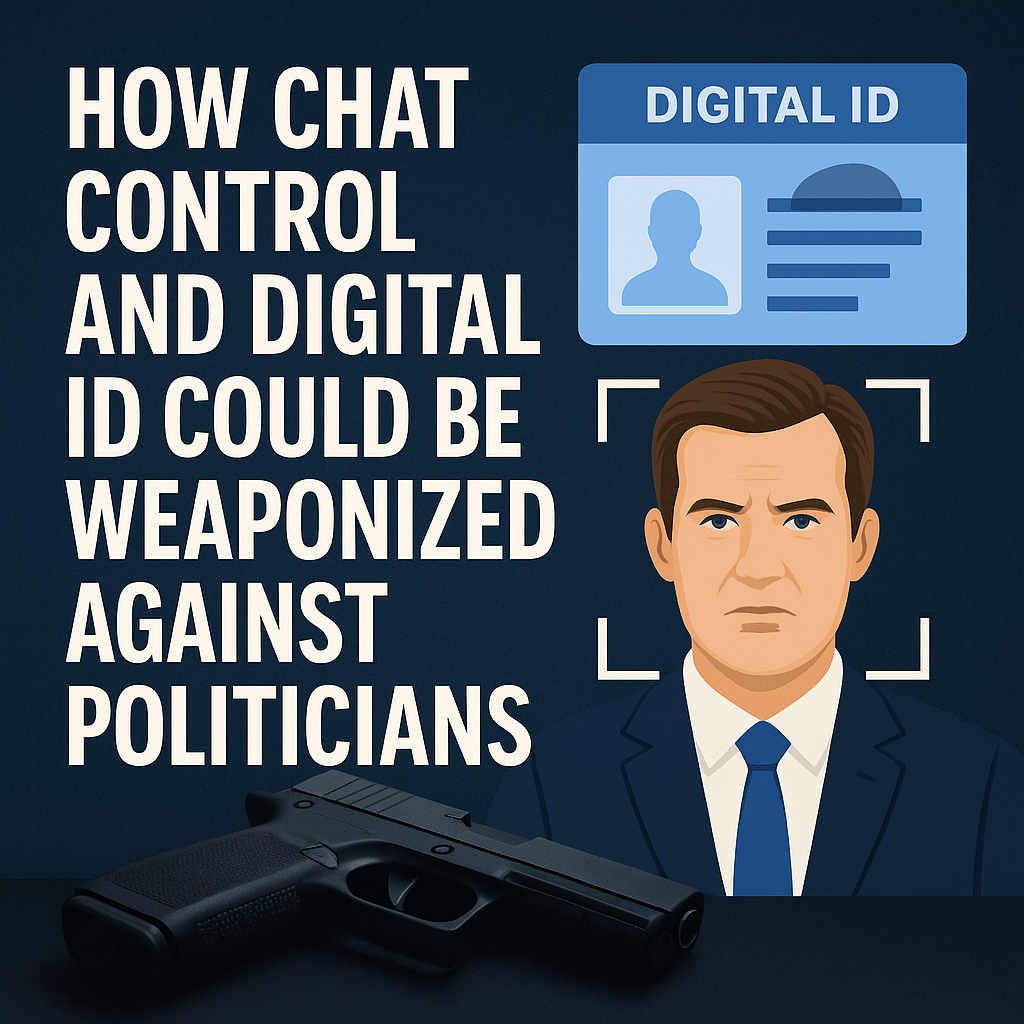


In 2025, under Denmark’s EU presidency, the European Commission’s so-called “Chat Control” proposal is being pushed forward again. On the surface, it’s being sold as a way to protect children and fight serious online crime. In reality, it’s one of the most dangerous steps towards mass digital surveillance we’ve ever seen in Europe.
The plan?
Mandatory client-side scanning of all private messages — WhatsApp, Signal, Telegram, Messenger, and potentially every other platform — before encryption even happens. Every photo, video, and piece of text you send would be scanned automatically, whether you’re suspected of a crime or not.
They call it safety.
I call it building the largest surveillance dragnet in history.
Why This Is a Dangerous Precedent
This isn’t just about “catching criminals.” It’s about rewriting the rules of the internet so privacy is no longer the default. If Chat Control passes, it sets a legal precedent that:
- Mass surveillance of innocent people is acceptable.
For decades, European law has been based on suspicion before investigation. This flips it — everyone is investigated all the time. - End-to-end encryption becomes meaningless.
Scanning happens on your device before encryption, so the privacy you think you have is already gone. - It can be extended to anything.
If scanning for one category of illegal content is allowed, nothing stops lawmakers from adding more categories — “hate speech,” “misinformation,” political dissent. - It creates the legal foundation for a Digital ID internet.
Once scanning is normal, the next step is requiring a verified ID to even access online services — a system already being discussed at the EU level.
Why It Won’t Even Work as Intended
Here’s the flaw that no one in favor of this law wants to admit:
- Criminals will simply adapt.
They’ll use layered VPNs, Tor networks, and encrypted storage outside major platforms. Anyone who knows what they’re doing can make tracking them nearly impossible. - Fake and stolen IDs will explode in value.
If a Digital ID becomes required for internet use, identity theft becomes the #1 criminal business. Want to ruin someone’s life? Route illegal traffic through their ID. - Innocent people will be blamed.
Data from these systems will be treated as evidence, even when it’s wrong. If your stolen ID is linked to illegal activity, you are now under investigation.
Weaponizing Chat Control Against Its Own Creators: The Fake ID + VPN Playbook
When lawmakers push for systems like Chat Control combined with mandatory Digital IDs, they believe it will make the internet “safe” by tying all online actions to a verified person.
They forget one thing: Any system that can be built, can be hacked, spoofed, or abused. And once you require a Digital ID for all online activity, that ID becomes the most valuable weapon in cyberwarfare — especially against the politicians who created it.
The Setup: How Digital ID-Linked Internet Works
If the EU moves forward with Digital ID + Chat Control, here’s the likely structure:
- Mandatory Authentication Layer
Before you connect to major services or even send data, your device will authenticate via your government-issued Digital ID (smartcard, app, or embedded chip). - Session Token Generation
The ID system issues a session token (cryptographic key) tied to your identity for the duration of your internet connection. - Traffic Logging
Every packet of data sent or received is logged and tied to that session token — creating a perfect trace from data → device → human. - Content Scanning & Flagging
Messages and files are scanned client-side, with flagged content directly linked to your ID in the central database.
The Attack: Turning the System on Its Creators
Now imagine you’re a malicious actor (state-level, cybercriminal group, or political enemy). You want to discredit or remove a lawmaker pushing for Chat Control.
Step 1: Acquire Their Digital ID Credentials
There are multiple attack vectors:
- Phishing — Fake government login pages harvest credentials.
- SIM-swap & 2FA hijacking — Redirect SMS-based verification codes.
- Insider leaks — Government contractors or employees sell access.
- Physical theft — Stolen smartcards, phones, or laptops with saved credentials.
Step 2: Build a Spoofed Authentication Node
Once you have the credentials, you can spin up a custom VPN endpoint that:
- Authenticates using the stolen Digital ID to the national gateway.
- Acts as a proxy for all malicious traffic.
- Encrypts and relays that traffic to multiple exit points worldwide.
Step 3: Route Illegal or Politically Sensitive Traffic
Now you push through:
- Highly illegal material (that will trigger automatic scanning alerts).
- Political dissent classified as “hate speech” in certain jurisdictions.
- False-flag communications to extremist groups.
The central logging system records every byte of this as coming from the politician’s verified Digital ID.
Step 4: Ensure Forensic “Plausibility”
To make it harder for the target to deny:
- Use their normal login times (from stolen schedule/calendars).
- Use residential IP geolocation matching their real address.
- Mix in normal traffic (news sites, work emails) alongside illegal content so it appears like genuine activity.
The Fallout: A Political Kill Switch
With these logs in hand:
- Law enforcement is obligated to act — The system they created says they did it.
- Media goes into frenzy — “Senator under investigation for…” headlines explode.
- Career destruction is instant — In politics, public perception kills faster than legal processes.
It doesn’t matter if they’re innocent. In a system where the database is treated as truth, they are guilty until proven otherwise — and proving otherwise is almost impossible when the “evidence” is government-verified.
Why This Is So Easy in a Digital ID World
The fatal flaw is centralization of trust:
- A Digital ID is a single point of failure for your entire online identity.
- If that key is compromised, everything you do (or are accused of doing) is tied to it.
- Unlike passwords, you can’t just “change” a government-issued ID overnight without triggering suspicion.
When combined with client-side scanning and full traffic logging, the system becomes a perfect frame-up machine.
The VPN Twist: Cloaking the Attack in Legitimate Infrastructure
A malicious actor doesn’t need to run a shady server in some back alley of the internet. They could:
- Lease legitimate cloud servers in politically neutral countries.
- Operate VPN nodes that also service real customers (mixing clean and dirty traffic).
- Use onion routing layers so even if a connection is traced, it appears to come from a different jurisdiction.
To the logging system, it still looks like the politician’s Digital ID was the origin point — and because the system trusts the ID, no one questions it.
Bottom Line: The Loaded Gun Analogy Is Real
By creating a system where every action online is tied to an unchangeable government-issued ID, lawmakers are building a weapon that:
- Can instantly destroy reputations.
- Can be fired remotely without the target’s knowledge.
- Will inevitably be turned against them.
It’s not “if” — it’s when.
for citizens — it’s a loaded gun lying on the table for anyone to pick up.
My Personal Action So Far
I’ve already taken steps to fight back:
- Contacted Danish political committees
I’ve written to the Folketing’s Europaudvalg and Retsudvalg detailing how Chat Control violates the Danish Constitution (§72), GDPR, and the EU Charter of Fundamental Rights. - Contacted the Danish Data Protection Authority (Datatilsynet)
I’ve asked for their legal assessment on whether this proposal is even compatible with existing privacy laws, and whether they plan to issue a public statement. - Shared awareness online
Posting in forums, social media, and direct discussions to make people aware this isn’t a niche tech issue — it’s about the future of how we communicate.
Going Deeper: The Digital Mechanics of Control
If implemented, Chat Control + Digital ID could look like this:
- Client-side scanning on your device
Every message, image, or file you send is checked against a database of “banned content.” - Flagging and reporting
If a match is found (or even suspected), your message is blocked and a report is sent to authorities. - Cross-referenced with your Digital ID
Every flagged message is tied directly to your identity, no matter where you are. - Network tracking
Your metadata (location, IP, device) is stored — and can be used to build a detailed profile of your online life. - Expanding the net
Over time, more content categories are added, and the list of “suspicious” behaviors grows.
The result? A system where privacy isn’t something you have — it’s something the state permits.
Why This Is Not Just a “Tech” Issue
Some will say, “If you’re not doing anything wrong, you have nothing to hide.”
That’s the most dangerous lie of all. Rights don’t exist to protect people doing “nothing wrong” — they exist to protect everyone, especially from abuse of power.
- Once surveillance is normalized, the definition of “wrong” can change overnight.
- Political opposition can be labeled as dangerous.
- Cultural differences can be targeted.
Today it’s about “protecting children.” Tomorrow it’s about silencing critics.
The Bottom Line
If this law passes, we are entering an era where every message you send is scanned by the state before you even hit send.
It won’t stop serious criminals — it will just push them into darker corners of the internet while stripping ordinary citizens of privacy.
It can and will be weaponized — against political enemies, journalists, activists, and yes, even the lawmakers who sign it into existence.
That’s why I’m speaking out, writing to politicians, and contacting oversight authorities. This is a fight we must win before the infrastructure of permanent surveillance becomes too deeply embedded to remove.
📢 If you value privacy, now is the time to act:
- Contact your national and EU representatives.
- Demand public legal reviews before any vote.
- Share this information widely — don’t let “child protection” be used as a smokescreen for building the perfect surveillance machine.



 Kiba Snowpaw
Leave a comment