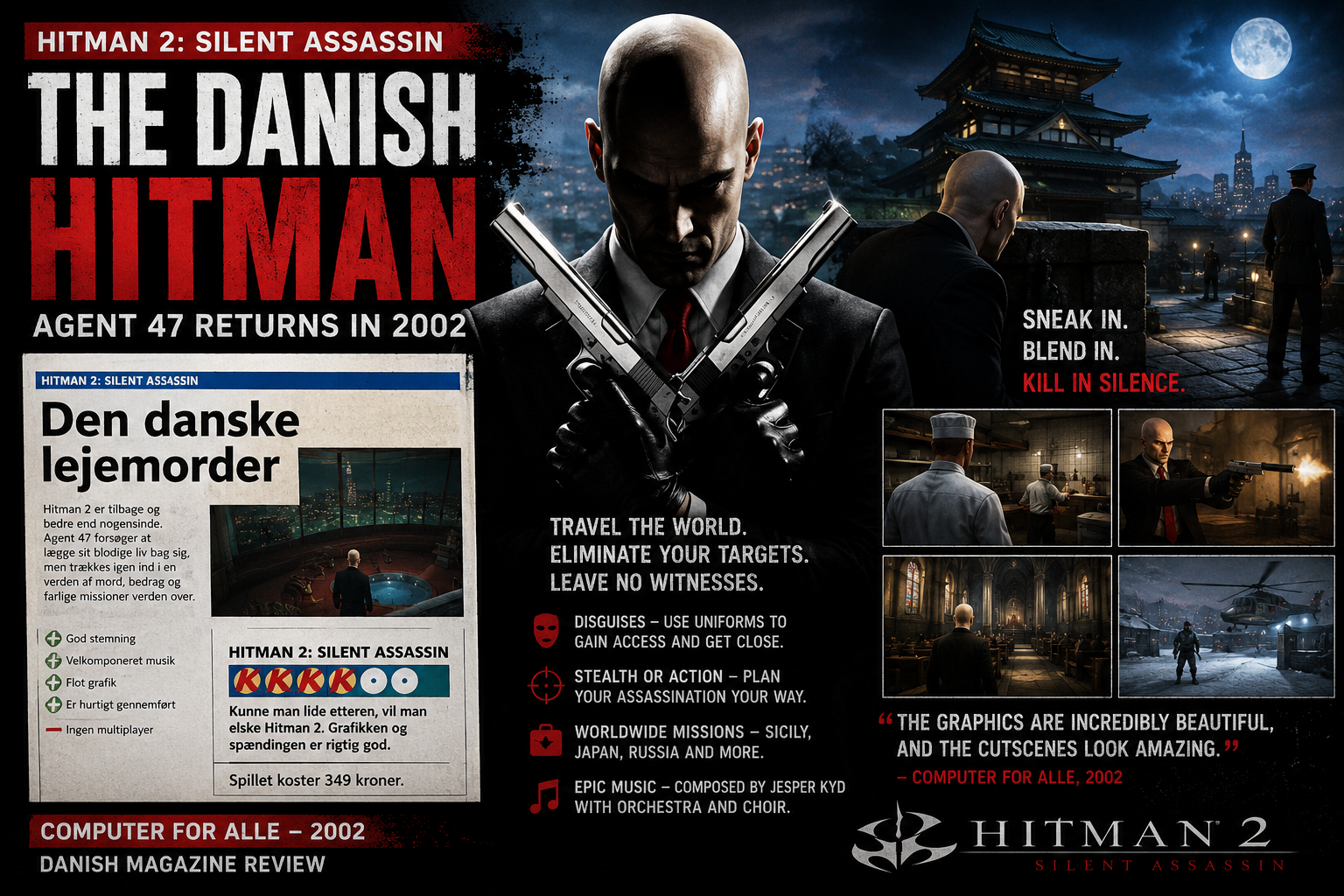



In 2002, Danish magazine Computer for Alle took a look at Hitman 2: Silent Assassin, the sequel to IO Interactive’s Hitman: Codename 47. Agent 47 was back with improved graphics, new missions, more weapons and an increased emphasis on completing assassinations without attracting attention.
More than two decades later, Hitman has grown into one of Denmark’s most internationally recognizable video game franchises. But looking back at Hitman 2 through a contemporary 2002 magazine is particularly interesting because it shows what people thought of Agent 47 before he became the gaming icon he is today.
The Danish Hitman
Computer for Alle gave its article the wonderfully direct Danish headline “Den danske lejemorder” — or “The Danish Hitman”.
That was appropriate. Hitman 2: Silent Assassin was developed by Copenhagen-based IO Interactive and followed the studio’s first Hitman game, Hitman: Codename 47, released in 2000.
Agent 47’s appearance had not changed dramatically. The bald head, black suit, white shirt and red tie were already becoming the visual identity of the series.
But the game surrounding him had become considerably more ambitious.
Agent 47 Tried to Leave Killing Behind
Hitman 2 begins with Agent 47 attempting to abandon his former profession.
He has withdrawn to a monastery in Sicily and works as a gardener while trying to distance himself from his violent past.
That retirement does not last.
When his friend and mentor Father Vittorio is kidnapped, 47 contacts his former employer, the International Contract Agency, for assistance. In exchange for information, he returns to doing what he does best.
Agent 47 is back in business.
Travel the World to Kill Your Targets
The game sends Agent 47 to several locations around the world while completing contracts and searching for information.
The 2002 Computer for Alle article highlighted the variety of situations available to the player.
One example involved eliminating a Mafia boss. Rather than simply walking through the front door and shooting everyone, the player could find ways around the guards, eliminate someone quietly, take their clothing and use the disguise to move through restricted areas.
That ability to steal clothing became one of Hitman’s defining mechanics.
Disguises Were Part of the Weapon
Hitman was never simply about having the biggest gun.
A uniform could sometimes be more useful than a firearm.
Players could disguise Agent 47 as different people to gain access to areas that would otherwise be heavily guarded. The challenge was figuring out which disguise would work, where it could be obtained and how suspiciously the player could behave before the deception collapsed.
Computer for Alle even mentioned a mission in Japan where Agent 47 could disguise himself as a ninja.
Of course, impatient players could often choose a much less subtle solution and simply start shooting.
Stealth Was Encouraged, but Violence Was Always an Option
This freedom was one of the interesting things about Hitman 2.
The game encouraged careful observation, disguises and quiet assassinations, but it did not always force players to use them.
If a carefully prepared plan failed, the situation could quickly turn into a gunfight.
This created a very different style of action game from a conventional shooter. Success was not necessarily determined by how many enemies you killed. A clean assassination with minimal unnecessary casualties could be the better performance.
Graphics That Impressed in 2002
Computer for Alle was particularly positive about Hitman 2’s presentation.
The magazine described the graphics as incredibly beautiful and singled out the game’s cutscenes as especially convincing.
It also praised the atmosphere and music.
The soundtrack was composed by Jesper Kyd and performed with the Budapest Symphony Orchestra and Choir, giving Hitman 2 a much larger and more cinematic sound than many action games of its era.
The magazine specifically praised the music for helping create the game’s cold and sinister atmosphere.
A Major Improvement Over the Original
Computer for Alle considered Hitman 2 significantly better than its predecessor.
The article highlighted more weapons, new missions and improved graphics, while describing the overall experience as more polished than the original Hitman.
That improvement was important for IO Interactive. Hitman: Codename 47 had introduced a distinctive concept in 2000, but Silent Assassin helped establish the formula that would continue developing through later games.
No Multiplayer — and Apparently Too Short
The magazine did have complaints.
Its two main negatives were straightforward:
- The game could be completed relatively quickly.
- There was no multiplayer mode.
The article estimated that an experienced player could finish the game in approximately 10 to 15 hours.
Today, the lack of multiplayer seems less important because Hitman became known primarily as a single-player stealth series. But in 2002, multiplayer was becoming an increasingly prominent feature in PC gaming, so its absence was worth mentioning.
349 Danish Kroner in 2002
The original Computer for Alle article listed Hitman 2: Silent Assassin at 349 DKK in Denmark.
That price is particularly useful as a historical snapshot because it comes directly from a Danish magazine published around the game’s original release.
The review was very positive overall, praising the atmosphere, music and graphics while criticizing its length and lack of multiplayer.
Hitman Became Much Bigger Than This 2002 Review Could Have Predicted
Silent Assassin was only the second Hitman game.
IO Interactive subsequently released Hitman: Contracts in 2004 and Hitman: Blood Money in 2006. Hitman: Absolution followed in 2012 before the series was reinvented again beginning with HITMAN in 2016.
The modern trilogy eventually became HITMAN World of Assassination, combining a huge collection of locations, targets, challenges and different assassination possibilities.
Looking at the relatively focused Hitman 2 from 2002 beside World of Assassination shows just how much the basic sandbox concept has expanded.
My Experience With Hitman Is Very Different
I have to add something important from my own perspective: I have never really been a Hitman fan.
That may sound strange considering that I currently have seven Hitman games in my Steam library.
Owning games and actually spending a lot of time playing them are two very different things.
I don’t remember spending a significant amount of time with the early Hitman games before Hitman: Absolution. Of the series, the games I have actually played to any meaningful degree are mainly Hitman: Absolution and Hitman: Blood Money.
I have also played some HITMAN World of Assassination, but that modern approach creates almost the opposite problem for me.
The sandbox has become enormous.
There are so many possible approaches, opportunities, challenges and ways of manipulating each location that I sometimes feel the game has become too much of a sandbox for my personal taste.
Why Absolution Worked Better for Me
This may also explain why Hitman: Absolution was one of the Hitman games I actually spent more time playing.
Absolution is generally more linear and cinematic than the traditional Hitman formula. IO Interactive itself described it as a different kind of Hitman experience built around a more personal journey for Agent 47.
For dedicated Hitman fans, that change in direction can be a weakness.
For someone like me, who was never particularly attracted to Hitman’s giant assassination sandboxes in the first place, some of those differences can actually make Absolution easier to get into.
Seven Hitman Games — Still Not a Hitman Fan
My Steam library today makes the situation slightly amusing.
I have seven Hitman games sitting there, covering a large part of the franchise’s history, yet I still wouldn’t describe myself as a Hitman player.
Blood Money received some of my time. Absolution received considerably more attention. World of Assassination received a little.
The others mostly sit in the library.
And that is one reason why finding this old Computer for Alle article is interesting to me. I can look back at how excited reviewers were about Hitman 2 in 2002 while knowing that, despite the franchise becoming enormous over the following decades, it never completely clicked with me.
A Piece of Danish Gaming History
Personal taste aside, Hitman 2: Silent Assassin remains important in Danish video game history.
IO Interactive was still a young Copenhagen studio, Hitman was only a two-game franchise, and nobody reading this magazine in 2002 could know exactly how long Agent 47 would survive.
More than two decades later, the bald assassin in the black suit and red tie is still here.
That makes this old magazine page more than just a review of another PC game.
It captures an early moment in what would become one of Denmark’s most recognizable contributions to international video gaming.
I may still not be much of a Hitman fan — but I can certainly respect what IO Interactive built.
Historical source: Computer for Alle, Denmark, 2002. The original Danish review praised Hitman 2: Silent Assassin’s atmosphere, orchestral music and graphics while criticizing its relatively short length and lack of multiplayer. The magazine listed the contemporary Danish price as 349 DKK. Personal comments about my Hitman experience and Steam library are my own.


Leave a Reply