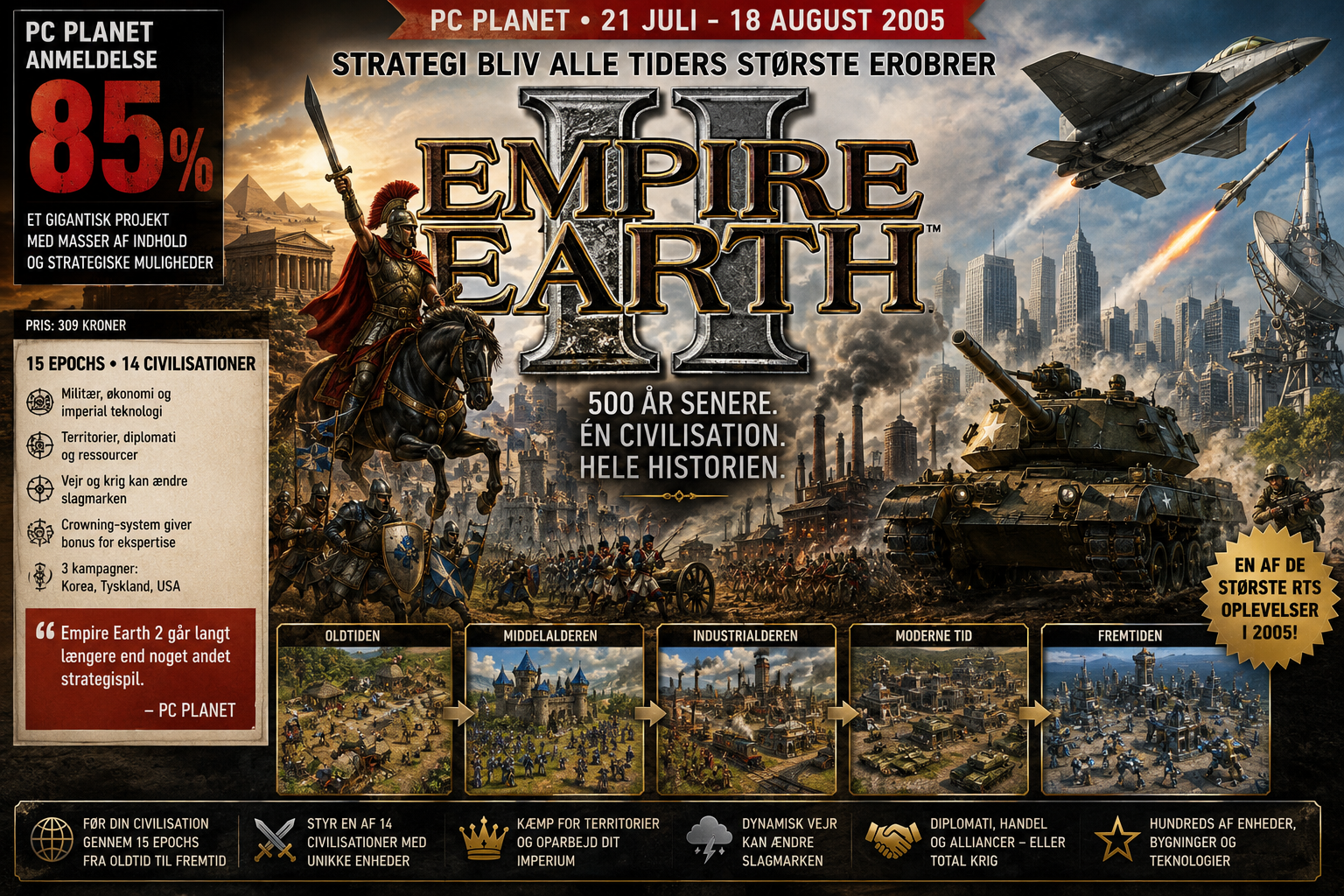



Empire Earth II was one of the biggest real-time strategy games of 2005, promising thousands of years of history, 15 epochs, huge armies and enough strategic systems to keep players busy for hours. PC Planet Denmark gave the game an 85% score in its July-August 2005 issue. I discovered Empire Earth later through a friend, but despite owning the games today, it never replaced Age of Empires as my favourite RTS series.
This old review comes from PC Planet issue 8, published for 21 July to 18 August 2005. Looking at it today is interesting because Empire Earth II was exactly the kind of PC strategy game that seemed enormous at the time.
The idea was simple in theory: start with an early civilization and build an empire across thousands of years of human history.
In practice, Empire Earth II tried to put an extraordinary amount of strategy into a single game.
Empire Earth II Was Built Around a Massive Historical Scale
Empire Earth II was developed by Mad Doc Software and published by Vivendi Universal Games in 2005.
The game contains 15 epochs, representing different stages of history from the ancient world into the future.
As your civilization advances, new buildings, technologies and military units become available.
The game includes 14 civilizations and several single-player campaigns, while skirmish and multiplayer allow players to build their own empires across the game’s enormous historical timeline.
PC Planet Called It One of the Biggest Strategy Games of Its Time
The Danish PC Planet review described Empire Earth II as a massive strategy game capable of keeping players occupied for a very long time.
The review praised the huge amount of content and the way the game combines historical periods into one continuous strategy experience.
PC Planet ultimately awarded the game:
85%
The magazine particularly praised the large number of strategic possibilities and the amount of content available to the player.
From Primitive Tribes to Advanced Warfare
The basic Empire Earth formula is immediately recognizable to anyone familiar with traditional real-time strategy games.
You gather resources, construct buildings, produce military units, research technologies and fight for territory.
The difference is the enormous timeline.
A match can begin with primitive warriors and basic settlements before eventually reaching tanks, aircraft and advanced technology.
That long technological progression is one of the defining features of Empire Earth.
15 Epochs and Changing Resources
Empire Earth II contains approximately 15 major epochs, with each one introducing new technologies, units and structures.
The resource system also changes as history progresses.
Players gather familiar resources such as food, wood and gold, but certain strategic resources become important only during particular periods.
For example, tin is useful during earlier eras, while iron, oil and uranium become important as civilization develops.
This means advancing technologically can sometimes create an entirely new problem: your empire may suddenly need resources that were previously irrelevant.
Military, Economic and Imperial Development
Technology is divided into three major categories:
- Military
- Economic
- Imperial
Players earn technology points and decide where to concentrate their development.
Empire Earth II also introduced a Crown system. Players who became the first to dominate one of these technology paths could receive special temporary bonuses.
This created a strategic choice between researching everything in an epoch or advancing more quickly into the next one.
Territory Became an Important Part of Empire Building
One of Empire Earth II’s major changes was its territory system.
The map is divided into separate territories, and controlling additional territory gives players access to more resources and strategic positions.
This prevented expansion from simply being about placing buildings anywhere on an enormous map.
You had to actively establish and defend control over different regions.
For an RTS built around creating an empire, that system made a great deal of sense.
Weather Could Affect the Battlefield
Empire Earth II also introduced dynamic weather.
Weather was not purely cosmetic. Different conditions could influence units and combat.
For example, severe weather could affect movement or visibility, while thunderstorms could cause problems for aircraft.
For a 2005 RTS, systems like this helped make the battlefield feel more dynamic.
Diplomacy Was More Important Than Before
Not every problem had to be solved by immediately sending an army.
Empire Earth II expanded diplomacy and allowed players to manage alliances, wars and resource tributes.
Players could cooperate with other civilizations or attempt to manipulate relationships before eventually turning against them.
Of course, when diplomacy stopped working, there were always tanks.
My First Experience With Empire Earth Came Later
I did not discover Empire Earth II when this PC Planet review was published in 2005.
I first really learned about Empire Earth through a friend who introduced me to the series sometime later.
I cannot remember the exact year, but I believe it may have been closer to 2010 than to the game’s original release.
That means my experience with Empire Earth is very different from someone who bought Empire Earth II when it was new.
I Grew Up With Age of Empires
For me, the important comparison has always been Age of Empires.
I grew up with Age of Empires, and I still consider it the best RTS series ever made.
That naturally affected how I reacted to Empire Earth.
Empire Earth offers a much larger historical timeline, more technological eras and an enormous amount of content, but bigger does not automatically mean better for me.
Age of Empires has always felt more focused.
I prefer its pacing, its historical identity and the way its economy and combat systems come together.
Empire Earth Was More Fun With Friends
The part of Empire Earth that really worked for me was multiplayer with friends.
That was where the enormous scope became entertaining.
When you are playing against friends, watching civilizations advance through completely different periods can create ridiculous situations.
One player might be technologically ahead while somebody else is desperately trying to catch up. Alliances can collapse. Resources disappear. Someone eventually produces an absurd military force.
That kind of chaos made Empire Earth fun for me.
Playing alone never had quite the same appeal.
I Still Own Empire Earth Today
I still own the Empire Earth games digitally on GOG.
I also own the original Empire Earth on physical disc, so the series still has a place in my PC game collection.
But owning a game and considering it one of your favourites are different things.
I respect what Empire Earth attempted, and I understand why people who wanted an enormous historical RTS could love it.
It simply never replaced Age of Empires for me.
Why Empire Earth II Was So Ambitious in 2005
Looking back at Empire Earth II today, its ambition is probably its most interesting feature.
Mad Doc Software tried to combine thousands of years of history with:
- 15 technological epochs
- 14 civilizations
- Hundreds of units and buildings
- Territory control
- Changing resources
- Weather effects
- Diplomacy
- Multiple technology paths
- Single-player campaigns
- Skirmish battles
- Multiplayer
Very few RTS games attempt to cover that much history inside one system.
PC Planet’s 2005 Verdict
The old Danish review clearly considered Empire Earth II a strong strategy game.
Its 85% score reflected praise for the game’s scale and strategic possibilities.
The magazine also listed system requirements including a 1.5 GHz processor, 256 MB RAM and a 64 MB graphics card, while recommending considerably stronger hardware.
Those numbers now look tiny, but in 2005 they represented the kind of PC specifications gamers actually had to think about before buying a new strategy game.
Empire Earth II Almost 20 Years Later
Empire Earth II remains an interesting example of how ambitious PC strategy games could be during the mid-2000s.
It wanted to let players experience almost the entire development of civilization in one RTS.
I never connected with it in the same way I connected with Age of Empires, and I mainly remember Empire Earth as something that became much more entertaining when played with friends.
But that does not diminish what the game attempted.
Empire Earth II wanted to give you thousands of years of warfare, technology and empire building in one box — and in 2005, PC Planet thought it deserved 85%.
Historical source: PC Planet Denmark, issue 8, 21 July – 18 August 2005. The original Danish review gave Empire Earth II an 85% score and praised its huge amount of strategic content. Historical game information has been cross-checked against surviving game documentation and contemporary sources. Personal comments about discovering Empire Earth through a friend, preferring Age of Empires, owning Empire Earth on GOG and owning the original game on disc are my own experience.


Leave a Reply