


I saw the news about Xodus and at first there is this obvious part of my brain that goes, okay, this is actually pretty damn impressive. An open-source project trying to bring Xbox PC games and potentially PC Game Pass to Linux by rebuilding the pieces Microsoft never bothered to provide there, using Wine/Proton, reverse-engineered Xbox runtime components, Microsoft authentication and the actual game packages. As of August 11, 2026, Xodus itself says it can already perform device and user login, Xbox authorization, download MSIXVC packages and obtain game licences, although plenty of work remains before this becomes some beautiful Heroic-style launcher where you sign in, see your library and press Install. Technically I love this kind of project. This is exactly the sort of stubborn engineering Linux has survived on for decades: somebody says “you can’t do that,” somebody else opens a terminal at two in the morning and eventually proves that apparently you can. I have spent stupid amounts of time myself getting Windows software to function through Wine because one tiny piece was missing, so I understand the mentality. But the more I think about Xodus, the more I keep coming back to a completely different question: are we solving the real problem here, or are we building an extremely clever bridge back into the exact ecosystem many of us went to Linux to get away from?
That is where this gets personal for me, because I did not suddenly discover computers last Tuesday. I have been gaming since the 1980s. Games are not just products that appear in a storefront and disappear when the next quarterly report arrives. I remember machines, rooms, disks, controllers, stupid hardware problems, the sound a particular computer made, who I was sitting beside when I played something, and entire periods of my life attached to games. I have something like 2,500 games on Steam, so this is not me standing outside digital gaming throwing rocks at something I never participated in. I participated in it completely. I bought into it. And over time I became less comfortable with what I had actually bought. I have also lived for decades with depression, anxiety and a brain that can run itself into the ground thinking about things, and I have spent a huge part of my life building routines and little systems of control because that is how I keep my head functioning. After losing my father, permanence and memory became even stranger things to me. When you have already learned in real life that something can be there one day and gone forever the next, you start looking differently at companies saying, “Don’t worry, it’s in your library.” My brain immediately answers: for how long? Under whose control? And what happens when somebody else changes the rules?
Xodus Is Brilliant, but Microsoft Is Still Sitting at the Other End of the Cable
The thing that bothered me at first was: where exactly does the game come from? Because an Xbox PC game is not normally sitting on some DVD waiting for Linux to read it. The answer is actually one of the most interesting parts of Xodus. You don’t need a disk. Xodus is working toward acting as an unofficial client for Microsoft’s existing infrastructure. The current code takes a Microsoft product, identifies a Windows Desktop package, authenticates against Xbox services and asks Microsoft for the package information; if Microsoft does not provide it, the Xodus code itself suggests checking whether the game is actually owned by the user. The package downloader then retrieves the actual files from Microsoft’s CDN, while other Xodus components handle Microsoft’s licence information and encrypted content keys. In other words this is not, at least from what the public project currently shows, “Hello Microsoft, trust me bro, I own Forza.” Microsoft is still involved in authenticating the account and returning what that account is entitled to receive.
And that is simultaneously why Xodus is so clever and why it does not solve my problem. I can install Linux. I can throw Windows out. I can replace the Xbox app. I can replace Microsoft’s implementation of xgameruntime.dll. I can use Proton, Wine, DXVK, VKD3D and whatever other dark magic the Linux community invents next Tuesday. But at the end of that chain there is still a Microsoft account, Microsoft authentication, Microsoft’s licensing servers and Microsoft’s CDN. Microsoft still has to say yes. Microsoft explicitly describes its digital goods as being “licensed, not sold,” and says access is subject to its licence terms and other conditions; licences can also involve account and device verification. So if your personal reason for leaving Windows is simply “Windows itself drives me insane,” then Xodus could be fantastic. If your reason is “I want less dependence on Microsoft and closed corporate services,” then congratulations, we just spent thousands of developer hours constructing an amazingly advanced Linux-shaped extension cable that plugs straight back into Microsoft.
And Then There Is the Part Nobody Likes Saying Out Loud: You Bought a Licence
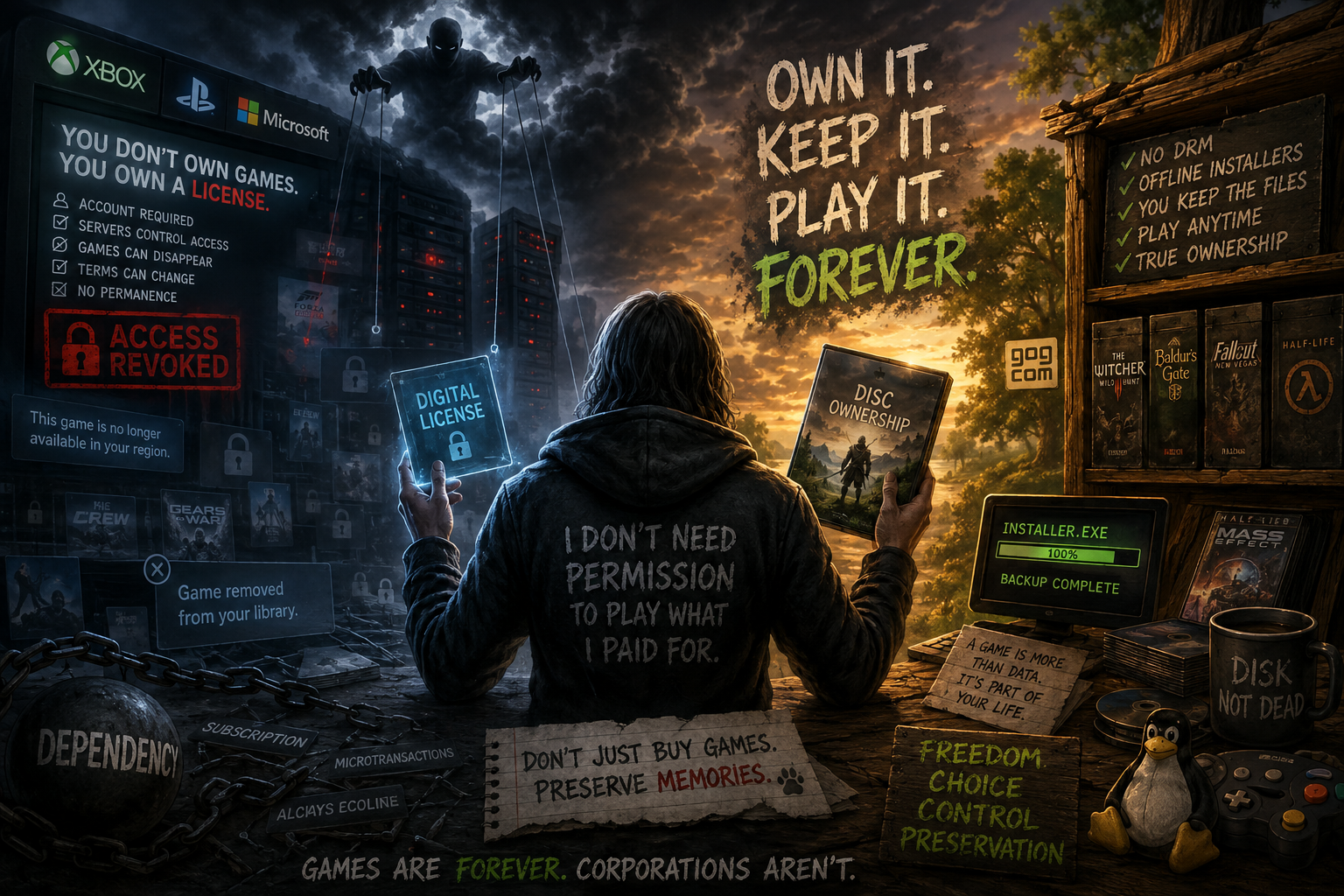
This is where my view of digital games has become pretty ugly, because I think the way we talk about buying them is almost dishonest even when the legal paperwork technically tells you what is happening. The store button says Buy. The receipt looks like a purchase. The price can be €70, €80 or more after DLC. Your library says “Your games.” Marketing talks about your collection. Everything about the transaction is designed to feel like ownership right up until ownership becomes inconvenient, and then suddenly somebody drags the licence agreement out from under a desk and explains that no, actually, you bought a limited permission to use some copyrighted software under conditions they control. Microsoft’s own rules are unusually clear once you actually go looking: its digital goods are licences rather than sales. Sony is not fundamentally different. PlayStation’s current Danish terms say that when you buy or download a digital product you purchase a personal licence, that you do not own the product itself, and that loss or suspension of the purchasing account can in some circumstances mean loss of access. Sony’s Danish software licence likewise states that PlayStation software is licensed rather than sold and explains that online services may eventually be discontinued.
Now, I want to be precise here because otherwise somebody will grab one sentence and go “AHA, WRONG!” Denmark and the EU do give consumers rights over paid digital content. Since 2022 Danish consumer law has specific rules covering digital content and digital services. A seller cannot simply ignore conformity requirements, and where certain changes materially harm use of an ongoing digital service, consumers can have rights including termination and refunds depending on the circumstances. So it would be legally wrong for me to write, “Microsoft can delete absolutely anything you bought tomorrow for any reason and you have zero rights whatsoever.” That is too simple. But consumer remedies are not the same thing as technical ownership. A legal claim after access disappears is not the same thing as holding a working installer in your hand. I do not want my preservation strategy to be “maybe contact customer service, quote EU consumer law, wait six weeks and argue about whether the loss was significant.” I want the file. I want the thing I paid for to continue functioning without having to ask permission again.
And that is why, emotionally, I keep comparing parts of digital gaming to the NFT rug-pull era, even though they are obviously not legally identical things. With a classic crypto rug pull the whole point was that people put value into something because they were convinced they possessed an asset, then the people controlling the infrastructure vanished with the useful value and everybody else was left staring at an entry on a screen wondering what exactly they had owned. Digital game stores are legitimate businesses selling legitimate licences, so I am not accusing Microsoft, Sony, Valve or anybody else of committing an NFT scam. That distinction matters. But the emotional structure can feel disturbingly similar: you give somebody money, your sense of security depends on infrastructure you do not control, and if the infrastructure or licence disappears your ability to use the thing can disappear with it. Game Pass makes that relationship even clearer because nobody even pretends the catalogue is permanent. Xbox regularly announces games leaving Game Pass and tells subscribers to purchase them if they want to continue playing after removal. That is fair for a subscription. You rented access. Fine. What bothers me is how much the permanent-purchase side of digital gaming has gradually started inheriting the same mentality.
This Is Why I Started Buying Disks Again
I have almost 400 games on disk now, and yes, I know physical media is not some magic holy shield that defeats every modern problem. A live-service game on a Blu-ray can still become a shiny plastic coaster when its required servers disappear. An online-only game cannot be resurrected just because there is a box on your shelf. Sony’s own current terms openly acknowledge that online services can be ended and that offline modes are not necessarily guaranteed forever. I am also not pretending every modern physical release contains a perfect, fully patched, eternal version of a game. My argument is not “disk good, internet evil” because reality is messier than that. My argument is control. If I have an old PC game on CD or DVD with a complete installer that does not require an online activation server, that object does something my Microsoft account library cannot: it exists independently of the company that sold it to me. I can take it off the shelf. I can install it on an old computer. I can make an allowed backup where applicable. I can preserve patches and documentation. Nobody has to look at a database and decide whether Kiba Snowpaw is still permitted to access a file he paid for twenty years ago.
There is something almost stupidly satisfying about that physical action now. I can literally turn around, pull a game box from a shelf, open it and there is the media. It has weight. Maybe the manual smells like somebody’s attic because I bought it used. Maybe the case has scratches. Maybe some teenager wrote the CD key inside in permanent marker in 2003. I don’t care. That history is part of the thing. Games used to arrive in our lives instead of being temporarily associated with our accounts. That probably sounds overly dramatic until you realise how many memories people attach to games. I can remember terrible PCs trying to run games they had absolutely no business running. I can remember hardware problems more clearly than some things I did last month. Games become landmarks in time. After everything I have been through, I don’t like the idea that the corporate version of preservation is an icon sitting in a database with a licence server standing behind it like a security guard. I already know what loss feels like. I do not need Ubisoft, Microsoft, Sony or anybody else turning nostalgia into another dependency that can disappear because a server migration no longer makes financial sense.
GOG Is Digital Too, but That Is the Difference I Actually Care About
This is also why I don’t simply say “all digital distribution is automatically bad,” because GOG demonstrates the difference between digital delivery and digital dependency. GOG’s developer documentation requires DRM-free releases to keep functioning without GOG Galaxy authentication or even the Galaxy client being installed for the offline parts of the game. GOG also produces offline installers which can be downloaded from a user’s library, and its own documentation describes Galaxy as optional. That matters to me enormously. I can download the installer, put it on storage I control, make backups, disconnect from the Internet and install it later. If GOG disappeared one day, a properly backed-up DRM-free installer does not suddenly wake up, smell that the corporation is dead and commit suicide. That is what I want when somebody uses the word “buy.”
People will correctly point out that copyright still applies. Obviously. Buying a DRM-free installer does not give me the right to upload it to fifty thousand people or start selling copies from my kitchen. Ownership of a physical game also never meant ownership of the copyright. But those concepts have been deliberately blurred in digital arguments. “You don’t own the copyright” does not logically require “therefore the publisher should maintain technical control over whether your legally acquired copy functions.” Those are separate ideas. I don’t own the copyright to a DVD movie either, yet the Warner Bros. legal department does not have to wake up and authenticate my copy every time I put the disc into a player. GOG’s philosophy proves that PC games can be commercially distributed without making continued company permission a prerequisite for basic offline use, and GOG’s Preservation Program explicitly frames offline DRM-free installers as a way to keep games usable even if central platform infrastructure changes or disappears. That is the direction I think PC gaming should have gone twenty years ago instead of slowly teaching people that convenience was worth surrendering control.
My PS5 Is Sitting There, and That Says Something Too
I own a PS5 and I more or less never use the thing. That is not because the hardware is incapable or because PlayStation suddenly forgot how to make games. Part of it is simply that the whole ecosystem feels increasingly like another controlled service wrapped around hardware I supposedly own. PSN has become clutter to me, and every time another account, entitlement check, online feature, subscription layer or store dependency gets inserted between me and pressing Play, my interest dies a little more. Sony’s Danish terms make the structure explicit: PlayStation Store digital purchases are personal licences, not ownership of the digital product, and the licence can be affected by account status; its software terms also allow online/network functions to end with notice. Again, those terms do not mean Sony randomly deletes everyone’s paid library for amusement. I am not claiming that. I am saying the architecture puts the important part under somebody else’s control, and I increasingly hate that architecture.
Xbox is even less attractive to me for the same reason. Game Pass can be good economic value if somebody wants a rotating subscription library and understands exactly what it is. Microsoft even cut the advertised US PC Game Pass price from $16.49 to $13.99 in April 2026 while changing parts of its release strategy. Fine. Somebody who wants that should use it. I am not standing outside their house shouting at them through the window because they subscribed to Game Pass. But I have reached a point where I would rather spend money on something I can preserve. Give me the disk. Give me a GOG installer. Give me a version I can put away and return to in fifteen years without hoping an authentication endpoint still answers. If that sometimes means buying an older version of a game instead of whatever shiny thing appeared this week, I can live with that. I have enough games to last multiple lifetimes anyway.
Linux Was Supposed to Give Me More Control, Not Just a Different Road to the Same Gatekeeper
This is where Xodus becomes almost philosophically funny. One of the things that attracts people to Linux is control. Not every Linux user is some anti-corporate hermit living inside a terminal, obviously, and plenty happily use Microsoft, Google, Steam, Discord and everything else. But Linux gives you the possibility of choosing your desktop, changing components, examining open-source code, replacing broken pieces and refusing certain defaults. Heroic exists because people wanted a native open-source way of handling Epic, GOG and Amazon libraries rather than blindly running every proprietary Windows launcher under Wine; Heroic itself describes its architecture as a native open-source launcher that relies on separate tools for authentication and downloading from those services. Xodus is born from exactly that same glorious Linux impulse: Microsoft does not provide what we need, so fine, we’ll build it ourselves.
But then you reach the end and the program still needs Microsoft to authenticate you. That contradiction is not Xodus’ fault. Xodus is actually exposing the contradiction that was already there. Linux can free my operating system while the games themselves remain chained to somebody’s account infrastructure. That is the difference between software freedom and content ownership. We have become unbelievably good at running Windows games without Windows. Proton is one of the greatest things that happened to desktop Linux gaming. We can translate DirectX calls, recreate Windows APIs, spoof environments and make games run on an operating system the publisher never officially supported. Yet after all that technical freedom, a tiny cryptographic token coming from a corporation’s server can still be the thing deciding whether the game belongs to me today. That is insane when you stop and actually look at it. We built the whole road ourselves and still arrive at somebody else’s toll gate.
Legally, even the Xodus side is more nuanced than people screaming either “completely legal!” or “piracy!” at each other. Danish copyright law contains specific rights concerning computer programs. Section 36 permits an authorised user in certain circumstances to observe, study or test a program to determine underlying ideas and principles, and Section 37 permits certain reproduction or translation of code when necessary to obtain information required for interoperability with an independently developed program, provided its conditions are satisfied. That gives clean-room interoperability work a real legal foundation in Denmark and the EU; it is one reason projects such as Wine can exist. It does not mean every possible method of accessing Microsoft’s private infrastructure is automatically authorised, and it certainly does not mean owning one game gives somebody permission to manufacture licences for games they do not own. Microsoft’s service terms and authentication rules still exist. Xodus itself warns that it is unofficial, not endorsed by Microsoft or Xbox and should be used at the user’s own risk. There is no need to exaggerate beyond that. The interesting legal question is not merely “did they reverse engineer something?” It is exactly how interoperability rights, contract terms, authentication systems and legitimate user entitlements interact, and until courts or Microsoft itself draw sharper lines around a project like this, anybody pretending the answer is perfectly simple is selling certainty they do not actually have.
Live-Service Games Are Where the Whole Illusion Finally Breaks
Then we get to live-service games, and this is where even having the files stops meaning very much. You can successfully download a package. You can decrypt the executable. Wine can run it. DXVK can make the graphics work. Xodus can recreate enough of Xbox Game Runtime that the title reaches its menu. Congratulations. Now the game phones home. The publisher wants an account. The game wants an Xbox token. Matchmaking wants authentication. Anti-cheat wants to inspect the environment. DLC wants another entitlement. A seasonal server wants to know whether you are really allowed through the door. Suddenly that hundred-gigabyte folder sitting on your SSD is basically a very elaborate corpse waiting for half a dozen external systems to give it a heartbeat. Microsoft’s own licensing model is built around account/device entitlements, and PlayStation’s current software terms similarly recognise that online functionality may eventually end. No compatibility layer can guarantee a publisher keeps servers alive.
That is why physical copies are not enough either for this particular disease. Preservation eventually has to be designed into games. If an online game reaches end of life, I think publishers should have an exit plan: remove mandatory authentication where possible, ship server software where legally and technically practical, provide LAN or offline modes where the game architecture allows it, or at minimum make clear before purchase that what is being sold is genuinely temporary. What irritates me is pretending something permanent was purchased when the architecture says otherwise. Call a rental a rental. Call a subscription a subscription. If a game is expected to exist only while a server exists, tell me that in giant letters next to the price instead of burying the reality in fifty pages of terms. I may still buy it. At least then there was an honest transaction.
So Do I Want Xodus to Succeed? Strangely, Yes
This is the funny ending because after all that ranting I actually hope Xodus succeeds. Completely. If somebody has a huge Xbox PC library, wants to move to Linux and Xodus eventually lets them log in through a Heroic- or Lutris-style interface, see the games they legitimately have access to, hit Install and play them through Proton without maintaining a Windows partition, that is fantastic for them. If Xodus eventually helps expose more Xbox PC titles to compatibility work, improves Wine’s understanding of GDK games and gives users another escape route from Windows 11, I am not going to complain. The project is technically fascinating, and open-source developers solving a problem the platform holder refused to solve deserves respect. Xodus is not the enemy in this story.
I just don’t think we should confuse escaping Windows with escaping the system that made Windows necessary. If I replace Microsoft’s operating system but I still require Microsoft’s account, Microsoft’s licences, Microsoft’s CDN, Microsoft’s Game Pass catalogue and Microsoft’s permission every time the important cryptographic pieces move around, I have moved the walls but I have not left the building. That might still be enough for somebody else. Good. Seriously. Use it. Enjoy it. Linux should be about giving people choices, including the choice to use Microsoft services from Linux if that is what they want. My own choice is moving in the opposite direction. I have already spent years filling enormous digital libraries. Now I find myself more interested in used disks, old PC games, preservation projects and DRM-free installers because they feel like something I can actually keep. It is almost backwards: the more advanced gaming technology becomes, the more I appreciate being able to pick up a twenty-year-old disk and know that this dumb circle of plastic does not know my password, does not care whether my account is suspended, does not need a corporation to remember I exist and does not have a server-side switch somewhere labelled ACCESS DENIED.
Maybe that is where the industry finally lost me. Not because digital distribution is inherently evil, and not because every publisher is waiting in a dark room planning to steal everybody’s games, but because we normalised a strange definition of ownership. We accepted Buy buttons that really meant Licence. We accepted games that need permission to keep functioning. We accepted subscriptions replacing libraries, accounts replacing objects and servers replacing permanence. Then we started building heroic open-source technology to maintain access to systems that were deliberately designed around somebody else retaining control. I can admire Xodus and still look at the whole thing and think: why are we working this hard just to convince a server that I should be allowed to play something I already paid for?
For me the answer is becoming simpler. Buy physical where the physical release actually gives you something preservable. Buy DRM-free where possible. With GOG, download the offline installers and back them up instead of assuming the store will exist forever; GOG explicitly designs its releases so the basic offline game does not depend on Galaxy authentication and provides offline installers for that purpose. Be extremely aware of what a live-service game really is before putting hundreds of euros into it. And when a store tells you something is “yours,” ask the annoying question I increasingly ask about everything digital: if this company vanished tomorrow, what exactly would still be mine?
If the answer is “the files on my disk still work,” good.
If the answer is “nothing, but my account page used to say I owned it,” then maybe I never owned very much at all.


Leave a Reply