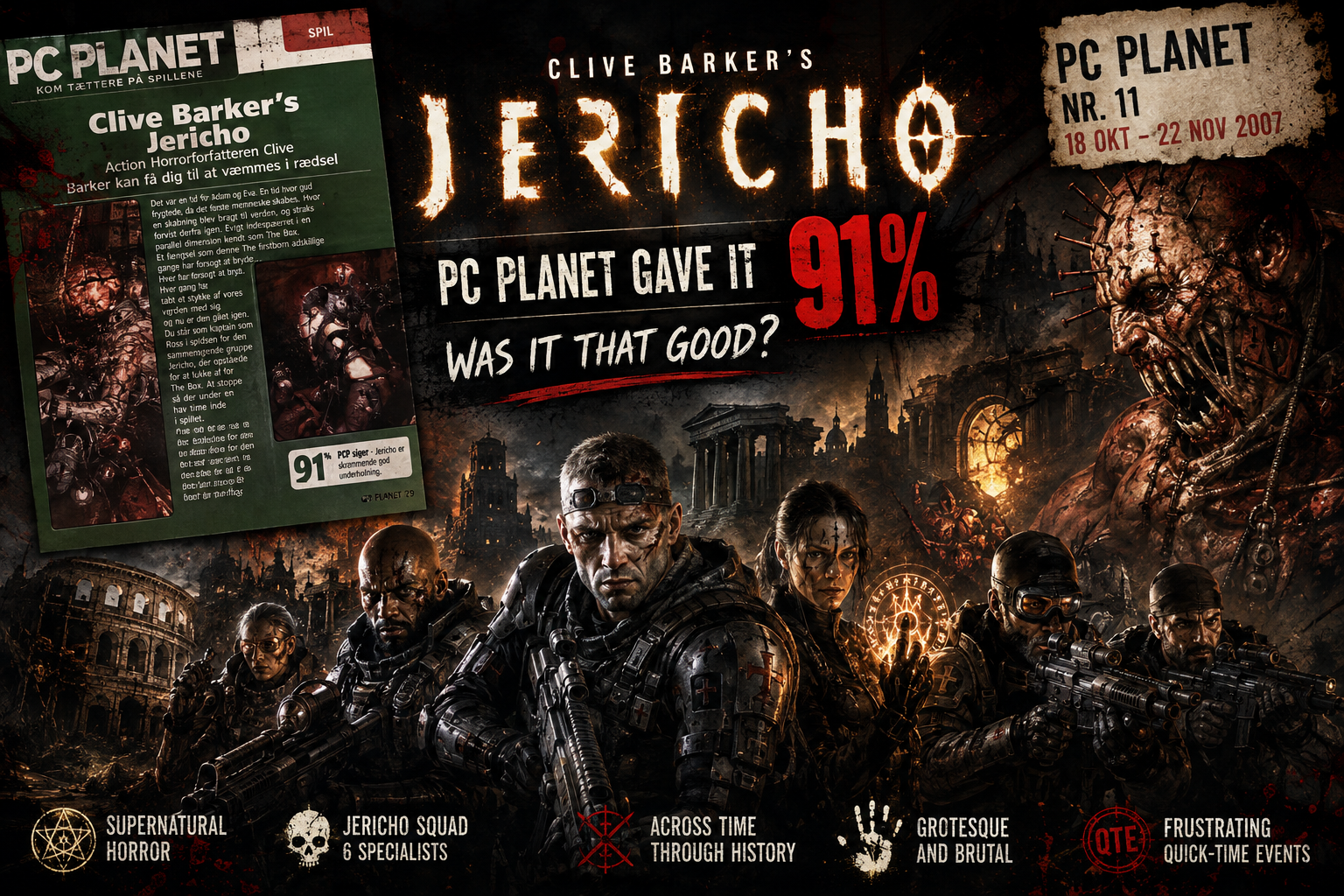



This Clive Barker’s Jericho review looks back at one of those strange cases where an old magazine review and my own experience with a game seem to describe almost two different products. In the autumn of 2007, Danish gaming magazine PC Planet gave Clive Barker’s Jericho an enormous 91% score and described it as an impressive mixture of horror, action and paranormal squad combat. I played Jericho on Xbox 360 when it was new, and I returned to it again later, yet my memory is almost the opposite of that glowing verdict. I remember the darkness, blood, monsters, disturbing architecture and strange supernatural atmosphere, but above everything else I remember frustration. I remember a game with fascinating ideas that repeatedly got between me and those ideas, and one mechanic in particular represents almost everything I dislike about a certain style of game design from this period: quick-time events. I hate QTEs. I hated them during the era when developers seemed determined to put them everywhere, and I still hate them now. Jericho is one of those games where they helped turn what should have been an intense supernatural journey into something I simply did not enjoy playing.
Finding this old PC Planet review nearly nineteen years later is therefore much more interesting to me than finding an article that simply confirms what I already think. The page comes from PC Planet issue 11, covering 18 October to 22 November 2007, almost exactly when Clive Barker’s Jericho was arriving on PC, Xbox 360 and PlayStation 3. PC Planet was clearly impressed. The magazine praised the atmosphere, action and technical presentation and awarded the game 91%, summarising it as “Jericho er skræmmende god underholdning,” essentially calling it frighteningly good entertainment. Yet the wider critical reception was far less enthusiastic. GameSpot awarded the game 6.5/10, while the Xbox 360 version ended up with a Metacritic average in the low sixties. That disagreement matters because it stops this retrospective from becoming a simple argument that PC Planet was “wrong.” Reviews are records of experiences, not mathematical measurements of quality. Someone at PC Planet genuinely experienced Jericho as one of the strongest games of that autumn; I experienced the same basic game on Xbox 360 and came away irritated by it. Both reactions reveal something important about Jericho, because perhaps more than many games from 2007, it is built from ideas that sound brilliant on paper while becoming considerably messier once the player has to interact with them.
Clive Barker’s Jericho Was an Extremely Ambitious Horror Shooter
Clive Barker’s Jericho was released in October 2007 for Windows, Xbox 360 and PlayStation 3, developed primarily by Spanish studio MercurySteam and published by Codemasters. The name attached to the project mattered enormously. Clive Barker was already internationally known for dark fantasy and horror, including the fiction that gave rise to Hellraiser, so Jericho was selling more than guns, monsters and another military campaign. It was selling the promise of entering a deliberately grotesque supernatural universe. The premise certainly justified that promise. Beneath the fictional city of Al-Khali lies the Pyxis, a supernatural prison containing the Firstborn, a being created before humanity and sealed away after its creation went catastrophically wrong. When occult forces threaten to release it, the Department of Occult Warfare sends in the Jericho Squad, a military unit whose members combine conventional weapons with supernatural abilities. The situation becomes increasingly impossible as the squad descends through different historical layers of the city, effectively travelling backward through corrupted periods of human history. World War II, the Crusades, ancient Rome and still older civilizations become layers of the same nightmare, each consumed by the influence of the Firstborn.
This remains one of the main reasons I cannot dismiss Jericho as merely a bad game. The premise is excellent. It contains the ingredients for exactly the kind of dark world that should remain inside your head long after the credits: history literally buried beneath history, soldiers walking deeper into humanity’s past while reality becomes less stable, ancient violence preserved as physical space, and death itself failing to behave normally. Even critics who disliked the finished game often recognized the strength of its audiovisual atmosphere and some of its more memorable set pieces. Jericho is not short of imagination. The game does not look as though someone designed a generic military shooter and then placed a few demons into it at the last moment. Its world feels diseased. Bodies, machinery, religion and architecture seem to melt into one another. Corridors resemble wounds. Creatures often look as though existing is physically painful for them. Blood is not merely an effect that appears when something is shot; at times it feels like part of the architecture itself. The game’s greatest frustration is therefore not that it has nothing to offer. It is that I can repeatedly see the shape of a much better game inside the one I am actually playing.
PC Planet Saw the Horror and the Spectacle — and Gave It 91%
The PC Planet article concentrates heavily on what Jericho does well aesthetically, and when I read it today I understand why somebody could have been overwhelmed by the presentation in 2007. The magazine describes strange paranormal creatures, oppressive environments, brutal violence and a story involving the Jericho Squad fighting through the twisted history of Al-Khali. It praises the graphics and the way the horror imagery creates something deliberately ugly and uncomfortable rather than merely putting ordinary soldiers into dark corridors. The review also discusses the squad system and the ability to move between different members of Jericho, each carrying distinct weapons and supernatural powers. Its final verdict is exceptionally enthusiastic: 91%. PC Planet essentially presents the game as frightening, exciting and technically impressive entertainment, and within the context of 2007 I do not think that reaction is impossible to understand. Jericho could look spectacular, especially during a period when the Xbox 360 and PlayStation 3 were still demonstrating what the new console generation could do compared with the hardware people had used only a few years earlier.
The monsters were grotesque combinations of mutilated flesh, metal, religious imagery, military equipment and impossible anatomy. Characters looked dirty and wounded rather than like clean action figures. Lighting could reduce corridors to suffocating tunnels before suddenly opening into enormous ruins or battlefields belonging to civilizations separated by centuries. On a decent television in 2007, that presentation could make a powerful first impression. The problem is that graphical horror and playable horror are not the same thing. A disturbing creature can make me uncomfortable because of what it represents, while a badly timed input prompt can make me angry because the game has suddenly stopped asking me to inhabit its world and started asking me to pass a reflex test. Jericho contains both kinds of experience. For me, the second repeatedly damages the first. I can be interested in a monster, an ancient ruin or the idea of a historical layer of suffering, but if my next interaction with that world is reduced to watching for a button prompt, the connection breaks. PC Planet apparently found the spectacle powerful enough to overcome that friction. I did not.
The Squad System Was Jericho’s Best Idea
Jericho’s most distinctive gameplay mechanic is still genuinely interesting. Captain Devin Ross begins as the squad leader, but the game does not remain a conventional shooter where one protagonist is controlled from beginning to end while computer-controlled companions follow behind. Ross eventually gains the ability to transfer his consciousness between surviving members of the Jericho Squad, allowing the player to jump from soldier to soldier and immediately gain access to a completely different combination of weapons and supernatural powers. One character can manipulate time, another can use fire, another possesses blood-related supernatural abilities, while others specialize in weapons such as sniper rifles or heavier firearms. Conceptually, this is excellent because the squad itself becomes the player’s arsenal. Instead of one hero apparently carrying ten rifles, explosives and magical powers in an invisible backpack, the player carries six human beings through the battlefield and selects whichever person best fits the immediate problem.
A distant enemy might encourage switching to a sniper. A crowded engagement might make another soldier more useful. A supernatural obstruction may require a particular ability. Death also becomes unusual because losing the body currently controlled by Ross does not necessarily mean an immediate game-over if other members of the unit remain alive. In theory, combat should therefore become a constant tactical dance of possession, positioning, supernatural powers, revival and adaptation. There are moments where that really does work, and those moments show why Jericho attracted defenders despite its mixed reception. When I am moving between different characters because the situation itself makes me want to switch, the mechanic feels clever and distinctive. The frustrating part is seeing how close the game sometimes gets to something genuinely special before restrictive level design, unreliable AI, repetitive encounters or scripted mechanics drag it back down. Jericho gives me one of the most interesting squad concepts of its era and then often fails to create the kind of battlefield that would allow that concept to become as important as it deserves to be.
The Problem Is That Jericho Often Gives Its Best Mechanics No Room to Breathe
A squad shooter built around several characters with different abilities needs space. It needs battlefields where positioning matters, enemies that force tactical decisions, and environments broad enough that switching characters genuinely changes what the player can do. Jericho frequently puts this elaborate system inside cramped corridors where squad members, monsters, weapons fire and visual effects collide with one another. Contemporary criticism noticed this too. Some reviews argued that the game’s best moments occurred when environments finally opened up and gave the squad room to operate, with larger areas such as the Roman arena demonstrating what Jericho could have been if more of the campaign had supported its central mechanics properly. Other players complained about repeatedly reviving fallen teammates, enemies feeling excessively resilient and combat spaces offering too little room to move, aim or evade attacks. This is where frustration becomes something different from simply saying that a game is difficult.
I do not object to difficulty by itself. A difficult game can be satisfying when failure teaches me something useful: I attacked too early, chose the wrong position, misunderstood an enemy, used the wrong character or failed to prepare. Frustration is different when failure feels like it came from fighting the structure of the game rather than solving the problem inside the game. Jericho can become visually chaotic while companions fall, enemies close the distance, supernatural effects fill the screen and the narrow architecture limits movement. Instead of feeling like the commander of an elite paranormal military unit, I can feel like someone trying to untangle six people in a hallway while demons keep punching everyone. The squad mechanic remains clever, but clever systems need environments designed to reveal their possibilities rather than constantly compress them. Jericho occasionally creates those situations, which makes the weak sections more frustrating because I know the system can work. The good moments do not merely show me what Jericho is; they show me what Jericho could have been.
Then There Are the QTEs — and This Is Where Jericho Loses Me
I really hate quick-time events. This is not something I decided after revisiting old games through modern expectations. It is a long-standing part of how I respond to game design, and Jericho is one of the games that illustrates exactly why. A QTE takes a sequence that visually appears to be dramatic interactive action and reduces my participation to waiting for the game to flash the correct button or direction at me. Instead of reading the environment, choosing a weapon, changing character, moving tactically or making a meaningful decision, I am watching for an interface command: press this now, then that, then another direction, and if the sequence is failed, repeat it. Players were complaining about these sequences around the time of release too, so this is not simply modern hindsight judging a design fashion that everyone loved in 2007. Some people enjoyed QTEs because they made cinematic sequences feel more interactive. I have almost always experienced them in the opposite way.
For me, the deeper problem is psychological rather than mechanical. Games work best when my attention passes through the controller and into the fictional world until I stop consciously thinking about the plastic object in my hands. I am not pressing a stick forward; I am moving through a corridor. I am not squeezing a trigger; I am firing at something coming toward me. I am not pressing a shoulder button; I am activating an ability because the situation calls for it. A QTE can violently reverse that relationship. Suddenly I am no longer looking at the monster, collapsing structure or desperate escape. I am looking for X, A, B or a directional prompt. The fictional danger becomes secondary to an abstract input examination. When failure sends me back to repeat the same sequence, whatever tension the scene possessed can rapidly turn into irritation. Horror depends heavily on immersion. Making me stare at controller prompts is therefore almost the opposite of what I want a horror game to do.
Why Frustration Affects Me More Than Simple Difficulty
My reaction to Jericho also makes more sense when I compare it with how I generally play games. I have been gaming since childhood, and I tend to approach games methodically rather than treating every encounter as a demand for instant aggression. In strategy games I naturally build an economy, produce workers, gather resources, research upgrades, prepare a strong army and make sure I feel ready before pushing forward. I tend to overprepare rather than attack too early. In role-playing games I prefer having enough time to understand the systems, develop a character and become absorbed in the world. Even in action games, I respond better when a challenge allows me to learn, prepare and deliberately execute something. Jericho repeatedly interrupts that mental rhythm. It can present an interesting tactical squad, then compress that squad into restrictive environments. It can build a disturbing scene, then insert a reflex-driven QTE. It can encourage me to inhabit several characters with different abilities, but sometimes the practical solution becomes finding the few characters I tolerate best and continuing with them until the game forces something else.
That is not about being unable to handle action. I have enjoyed games considerably more aggressive than Jericho. The difference is whether I feel that I am controlling the action or merely obeying it. When a game repeatedly demands an immediate arbitrary input, my mind does not interpret that as deeper involvement. I feel less involved. Instead of entering the flow state where the controller almost disappears and mechanics become an extension of what I am trying to do, I become increasingly conscious of the designer standing behind the screen saying, “Press this button now.” Once I notice that machinery, rebuilding immersion becomes difficult. In a horror game where atmosphere is one of the strongest reasons to continue, that damage matters enormously. A difficult tactical decision can engage my mind for a long time. A repeated QTE can exhaust my patience in seconds because there is almost nothing for me to think through except remembering what the game demands next.
Jericho’s Horror Is More Grotesque Than Frightening
There is another distinction worth making when discussing Jericho as horror: disgusting, disturbing and frightening are not synonyms. Clive Barker’s influence gives the game grotesque imagery in abundance. Bodies are mutilated, flesh is transformed, architecture becomes almost organic, enemies appear tortured by their own existence and historical violence is mixed with supernatural corruption. The result can be deeply unpleasant to look at, deliberately so. But I do not remember Jericho primarily as a game that made me frightened to continue. I remember it as oppressive, ugly, bloody, stressful and mechanically irritating. Contemporary criticism was divided on this issue as well. Some players found the atmosphere genuinely disturbing, while others felt that the game relied more heavily on grotesque imagery than actual fear. I understand that reaction because effective horror usually needs contrast. Darkness becomes more threatening when there has been light. Silence becomes meaningful after noise. Isolation matters more after human contact. Vulnerability becomes frightening when the player understands what can be lost.
Jericho often keeps turning the grotesque dial upward until horror becomes the normal environmental state. When everything is blood, tortured flesh, darkness, screaming monstrosities and religious corruption, the extraordinary eventually risks becoming ordinary. I can appreciate the art direction intellectually while becoming emotionally numb to it. The first creature that looks as though its body has been turned inside out can be disturbing. The tenth can become another enemy type. After enough beautifully disgusting monsters, my reaction becomes less “What the hell is that?” and more “Fine, what do I have to shoot now?” This does not mean the art direction failed. In some ways it succeeded too consistently. The game rarely provides enough normality for the abnormal to regain its power. As a result, I often felt more stress from the gameplay systems than fear from the world itself, which is probably not the emotional balance a supernatural horror shooter wants.
There Is Something Personally Familiar About Jericho’s Layers of Buried History
Where Jericho becomes more interesting to me today is not actually in its shooting but in its central metaphor: a place containing layers of history that are still present underneath the current surface. The squad moves physically backward through eras, entering older wounds rather than leaving them buried, and every layer has its own violence waiting inside it. That idea resonates with me more now than the game itself did in 2007. There are places in my own life that work almost like that, especially Holbæk. I know Holbæk extremely well because different parts of my childhood and later life happened there: years at Orøstrand, school at Bjergmarkskolen, long periods at Holbæk Library, later technical-school programs and eventually living alone there in a one-room apartment. When I return, the streets can be recognizable and foreign at the same time. A location is physically still there, yet what I experience is not simply the location as it exists today. Older versions of myself are layered across it.
One street belongs to one period. Another building opens another mental room. The library can be a physical building in the present while simultaneously belonging to a completely different time inside my memory. Experiences that have nothing to do with the current moment can suddenly move from the background into the foreground. Jericho literalizes something psychologically recognizable: you can walk forward geographically while travelling backward emotionally. Obviously my life is not a supernatural horror story, and I would not trivialize real memories by pretending a videogame demon is equivalent to them. The comparison is narrower and more useful than that. Places retain associations. Memory does not organize itself like a clean chronological save file. Sometimes the oldest layer is not gone merely because newer structures were built above it. Jericho’s strongest image may therefore not be any individual monster but the idea that history remains underneath us, and that sometimes continuing forward requires moving through something old again.
Games Can Be a Form of Control — Which Makes Jericho’s Interruptions More Irritating
Gaming has occupied an enormous part of my life, from the games I grew up with to the physical PC collection I maintain today, and part of what games can provide is a structured space where actions have understandable consequences. Real life frequently refuses to operate that way. You can prepare carefully and still lose something. You can do everything available to you and still discover that there was no correct button, dialogue option or strategy capable of producing the ending you wanted. Games are artificial systems, and that artificiality can be comforting precisely because the rules can usually be learned. If I lose an Age of Mythology mission because I expanded too slowly or misunderstood the objective, I can restart with new knowledge. If an RPG battle defeats me, I can change equipment, reconsider tactics or return stronger. Even failure can contain information. That agency is important to why I play.
Jericho contains the beginnings of a system that should appeal strongly to that side of me: specialists, different powers, tactical switching, healing, positioning and decisions about which body Ross should inhabit. Yet QTEs strip that agency down to obedience. They do not ask, “What will you do?” They say, “Do exactly this immediately.” Another player may experience that demand as adrenaline. I experience it as the game grabbing the controller back while pretending I am still the one controlling the sequence. That becomes especially irritating when gaming is supposed to provide somewhere for my mind to focus rather than another system shouting an urgent instruction. A difficult tactical decision can engage me. A repeated QTE can simply drain my patience. That distinction explains why I can tolerate a slow strategy mission for a long time, building resources and preparing for an attack, while becoming angry at a thirty-second series of flashing button prompts. Duration is not the issue. The form of control is.
Death, Possession and the Strange Idea of Continuing Through Someone Else
There is nevertheless something emotionally potent in Jericho’s treatment of death. Devin Ross does not continue because his own body survives; he continues by transferring his consciousness into other members of his team. Mechanically, this provides the character-switching system, but thematically it produces a stranger question about identity. If your body is gone but your consciousness continues through other people, what exactly remains of “you”? Jericho does not explore this with anything approaching the depth it could have, but the idea is there, and it hits differently when viewed after experiencing grief rather than simply as a younger player shooting monsters on an Xbox 360. After my father’s death, I became much more aware of the strange ways a person can remain present without physically being there: routines learned from them, phrases, habits, objects, memories attached to places and decisions influenced by what they would have thought.
That is not supernatural possession, and I do not mean it literally. Human identity does, however, continue socially and psychologically through other people. We carry fragments. Jericho turns carrying another person into a literal gameplay system: Ross enters another body and continues the mission. Real grief is far less convenient. There is no transfer that restores conversation, no mechanic that lets someone return, and no checkpoint from before the moment everything changed. Perhaps this is another reason games built around control can become so psychologically interesting. They construct worlds in which even death can sometimes be converted into a mechanic, a rule or a state that can be understood and manipulated. Reality offers no such clean system. Jericho’s fiction can therefore accidentally touch something much heavier than its action-horror presentation suggests, even though the game itself rarely stops shooting long enough to explore what its own mechanic might mean.
The Game Also Suffers From the Difference Between Having Variety and Using Variety Well
Six playable squad members sounds like enormous variety, but numerical variety does not automatically create meaningful variety. Some players naturally settled on a few preferred characters and ignored others except when the game specifically required a particular power, and I understand that completely. If one character feels comfortable, has useful weapons and solves most encounters efficiently, the theoretical freedom to control six people becomes less important. Good character-switching design needs situations where I voluntarily think, “This is a job for that person,” rather than the game constructing a supernatural lock that effectively says, “Please equip the correct key.” Jericho occasionally achieves the former but too often falls toward the latter. The same problem appears in many games with huge weapon lists, enormous skill trees or dozens of abilities: developers can advertise quantity while players discover that only a small subset is actually enjoyable or efficient.
What matters is not whether I technically have six characters. What matters is whether the combat makes me want six characters. Jericho’s cramped environments and sometimes unreliable squad behaviour undermine that desire because switching can feel like additional management during an already messy encounter. When possession works properly, it feels immediate and satisfying. I see a problem, identify the squad member who can solve it and become that person. When it fails, I am no longer thinking about supernatural strategy; I am wondering why somebody has fallen again, whether I need to stop shooting to revive them, or whether another character is blocking the space I need. The difference between those two experiences is the difference between Jericho’s promise and Jericho’s reality. It contains variety, but it does not always turn that variety into meaningful agency.
2007 Was an Especially Brutal Year to Be a Merely Interesting Shooter
Historical context matters as well. Jericho did not release into an empty market. 2007 was an extraordinary year for video games. On Xbox 360 alone, players were surrounded by major releases and rapidly evolving expectations for first-person action. BioShock had arrived only months earlier with an unforgettable world and environmental storytelling. Halo 3 launched in September. Call of Duty 4: Modern Warfare followed shortly after Jericho in November and helped redefine mainstream military shooters. The Orange Box brought Half-Life 2: Episode Two, Portal and Team Fortress 2. Against that competition, “interesting but frustrating” was a dangerous place to be. Jericho possessed a visual identity that many shooters lacked, but identity alone could not hide cramped encounters, limited replay value and design decisions that were already irritating some players at release.
The campaign was also relatively compact, with reviewers often reporting a completion time somewhere around eight to ten hours, and there was no competitive or cooperative multiplayer mode to provide an alternative reason to keep playing. None of those things automatically make a game bad. I would rather have an excellent eight-hour game than a mediocre eighty-hour one. Short length can even improve pacing when every level justifies its existence. The problem is that a short linear campaign becomes harder to defend when substantial parts of those hours are frustrating. In a year overflowing with games people would still discuss decades later, Jericho needed its strongest ideas to work consistently. They did not. A game like BioShock could combine an unusual world with mechanics that reinforced its identity. Portal could turn one central mechanic into an entire language. Jericho had several strong concepts competing for attention, but too often the level design and scripted action stopped those concepts from reaching their full potential.
PC Planet Was Not Necessarily Wrong — But 91% Captures Only One Side of Jericho
This is why I do not want to rewrite history by simply declaring PC Planet’s reviewer incompetent. A 91% score looks astonishing when placed beside a Metacritic score in the low sixties, but individual criticism has value precisely because people respond differently. PC Planet clearly valued the things Jericho does best: its visual imagination, atmosphere, occult concept, historical settings, violent action and squad mechanic. Someone who can tolerate its cramped spaces and QTEs may experience those strengths much more strongly than I do. There are players who still defend Jericho as underrated, while others remember it as a deeply frustrating missed opportunity. That polarization is arguably more revealing than an average score. Jericho is not bland, and bland games rarely produce arguments almost two decades later.
It reaches toward something unusual and occasionally touches it, then undermines itself with design decisions another player may forgive and I cannot. The PC Planet review preserves the experience of somebody caught by the game’s atmosphere at exactly the right historical moment, when its graphics were fresh, the Xbox 360 and PlayStation 3 represented the new console generation, and the combination of supernatural soldiers, historical horror and Clive Barker grotesquerie looked distinctive. My memory preserves another side: the person sitting with the controller, irritated that an interesting horror world keeps demanding inputs I fundamentally dislike. Neither memory erases the other. That is one of the reasons I find old magazines so interesting today. They do not only preserve facts about games. They preserve reactions before later reputation, nostalgia, Metacritic averages and twenty years of discussion have told us what we are supposedly meant to think.
Returning to Jericho Later Did Not Change My Mind
I played Jericho when it came out on Xbox 360 and returned to it once later, which matters because nostalgia can sometimes repair a game’s reputation inside my own head. There are games I remember more fondly after years away because I forget irritating details and retain the atmosphere, music, characters or sense of discovery. Sometimes replaying something shows me that the old problem was partly my own lack of patience or understanding. Jericho did not undergo that transformation for me. Returning did not reveal a misunderstood masterpiece hidden beneath my younger impatience. The same fundamental friction remained. I could still appreciate what the artists were doing. I could still recognize the cleverness of possessing different squad members. I could still look at the historical horror premise and think that somebody should do more with an idea like this. But appreciation is not enjoyment.
That distinction is important in criticism. I can respect a game’s ambition without liking the act of playing it. I can recognize technical accomplishments without wanting another hour with its mechanics. I can even understand exactly why another reviewer awarded 91% while knowing I would never come close to that score myself. My dislike of QTEs has only become clearer over time because I better understand what I want from interactive storytelling: I want mechanics to deepen the connection between me and the world, not remind me that I am following instructions. Jericho repeatedly reminds me that I am following instructions. When the atmosphere says “survive this nightmare” but the interface says “press the displayed button before the timer expires,” the interface wins, and the nightmare becomes software. Returning years later did not make me hate Jericho more. It simply gave me better language for explaining why I never loved it in the first place.
Jericho Is Almost More Interesting as a Failure Than It Would Have Been as a Safe Success
That may sound excessively harsh, but I use “failure” here in the sense of unrealized ambition rather than worthless creation. Jericho contains too many interesting pieces to be worthless. Its squad-possession system remains unusual. Its biblical mythology is more imaginative than the generic conspiracies used by countless shooters. Its historical descent gives the campaign a powerful visual structure. Its character designs and monsters can still be striking. Its commitment to grotesque horror is unmistakable. What makes the game frustrating is precisely that these strengths allow me to imagine the better game trapped inside it. Give the squad larger and more tactically varied spaces. Improve companion behaviour. Replace QTEs with actions performed through normal controls. Give each character more encounters designed around voluntary tactical switching. Allow the story time to breathe between firefights. Explore what it actually means for Ross to exist through his teammates. Develop the Firstborn beyond an excuse for progressively uglier monsters.
Give the ending enough space to resolve the questions the narrative spends hours establishing. Add cooperative multiplayer to a game already structured around a squad of supernatural specialists. Suddenly Jericho begins to sound extraordinary. There is a peculiar sadness in games like this. A terrible idea executed terribly is easy to forget because there is little reason to imagine an alternative. A brilliant idea executed inconsistently stays in the mind because you can see the road it almost travelled. Jericho keeps providing evidence of its own potential. The larger encounters show that the squad system can work. The strongest visual sequences show that the historical-horror premise can produce memorable imagery. The possession mechanic shows that a first-person shooter can treat the playable character as something more fluid than a single body. Every successful idea creates another reason to be disappointed when the rest of the game cannot consistently rise to it.
My Verdict in 2026: The 91% Review Is Fascinating History, but It Is Not My Jericho
Almost nineteen years after PC Planet printed this review, I can appreciate the page more than I appreciate the game. It captures October 2007 before history had decided what would become a classic, what would become a franchise and what would largely disappear. There is Clive Barker’s Jericho receiving 91%, presented as frighteningly good entertainment, with no knowledge that there would never be the major Jericho series its world seemed capable of supporting. There is the promise of supernatural squad warfare, grotesque monsters and centuries of buried evil. Somewhere outside that magazine page is my younger self playing the Xbox 360 version and discovering that none of those ingredients could overcome how frustrated the game made me. I do not dislike Jericho because I think it contains nothing worthwhile. In some ways that would be easier. I dislike it because it keeps showing me things I want to like and then placing mechanics I dislike between me and them.
The QTEs are the clearest example, but they represent the larger problem: Jericho too often substitutes forced interaction for meaningful agency. For somebody else, that may be a small complaint inside an atmospheric horror shooter. For me, agency is one of the central reasons video games matter as a medium. I want to enter a world, understand its rules, make decisions and feel that my actions belong to me. Jericho gives me glimpses of that experience when I switch between supernatural soldiers and adapt to a battle, then suddenly asks me to watch for a button prompt. That interruption may last seconds, but psychologically it can collapse everything the atmosphere spent minutes constructing. My problem with Jericho is therefore not that it asks me to interact too much. It is that some of its interaction feels less meaningful than simply being allowed to control the character normally.
So if I were writing the little score box beneath PC Planet’s original 91% today, I would not call Clive Barker’s Jericho a forgotten masterpiece, nor would I call it one of the worst games of 2007. I would call it something more frustrating: a fascinating horror game whose imagination is better than its execution. It has a world worth remembering, mechanics worth studying and images capable of surviving in memory long after the exact firefights disappear. It also has restrictive level design, uneven combat, limited replay value, an abrupt conclusion and QTE sequences that embody a style of game design I have never enjoyed. Contemporary criticism supports many of those complaints, which means my negative memory is not simply modern hindsight fighting with an old 91% review. Players and critics were arguing about Jericho from the beginning. That is ultimately why this old PC Planet page deserves preserving. It is evidence of a moment when one reviewer looked into Jericho’s darkness and saw a 91% game. I looked into much the same darkness on my Xbox 360 and saw something else: an ambitious, grotesque, sometimes impressive journey that kept pushing me out of its world whenever I was beginning to enter it.
Nineteen years have made me more interested in understanding why the game failed for me, but they have not made me enjoy it. Sometimes revisiting an old title radically changes your opinion. Sometimes you discover that a game you dismissed was deeper than you understood. Sometimes nostalgia makes something feel better than it really was. Jericho sits in another category for me. Returning to it did not rewrite the memory. Instead, growing older, playing more games and understanding my own preferences better gave me a clearer vocabulary for the same reaction. I value preparation over arbitrary reflex checks. I value systems that allow me to understand why I failed. I value worlds that let immersion build instead of interrupting it with interface commands. I can respect grotesque art without being frightened by it, and I can admire an ambitious mechanic without pretending the game surrounding it uses that mechanic well. PC Planet’s 91% remains fascinating because it demonstrates how radically another player could experience the same work. I do not need to agree with that reviewer for the old review to be valuable. In fact, the disagreement is precisely what makes it worth returning to.
Historical Source and Review Context
Historical source: PC Planet Denmark, issue 11, 18 October – 22 November 2007. The photographed review awarded Clive Barker’s Jericho 91% and praised its horror atmosphere and entertainment value. Clive Barker’s Jericho was released in October 2007 for PC, Xbox 360 and PlayStation 3, developed primarily by MercurySteam and published by Codemasters. Wider contemporary reception was considerably more mixed than PC Planet’s verdict, with GameSpot awarding the game 6.5/10 and the Xbox 360 version receiving a Metacritic average in the low sixties. Personal discussion of playing the Xbox 360 version at release, returning to the game later, disliking QTEs and comparing its themes of memory, control, identity and loss with my own experiences is personal retrospective commentary rather than part of the original PC Planet review.


Leave a Reply