



Final Rating: 4.07/5.00
- Starting score: 2.50
- +0.46 for making Regeneration a powerful metaphor for the difference between physical survival and psychological recovery
- +0.34 for the patient, boundary-conscious trust built between Benedict and Atropos
- +0.20 for giving cooking, shared routines, and ordinary care genuine found-family meaning
- +0.21 for an accessible progression system and combat roles that complement the characters
- +0.64 for Andrea Parsneau’s distinct voices, emotional control, and ability to strengthen difficult scenes
- +0.12 for clear, unobtrusive audio production that preserves immersion
- +0.11 for allowing the romantic direction to develop slowly without erasing consent or personal agency
- +0.15 for a supporting cast that gives the academy warmth beyond the central relationship
- -0.17 for repetitive cycles of meals, training, reassurance, and similar emotional conversations
- -0.15 for trauma responses that are often resolved too cleanly and verbally
- -0.16 for ending immediately before the mock-war payoff the final act spends so long preparing
- -0.08 for leaving the larger science-fantasy world less developed than its ideas deserve
- -0.06 for recurring dialogue-tag errors, agreement slips, and repetitive sentence habits
- -0.04 for antagonists who are effective threats but rarely convincing people
- Calculated final score: 4.07/5.00
Content note: This review discusses child abuse, bullying, sexual trauma, depression, panic, emotional shutdown, and suicidal thoughts without revealing the book’s largest plot turns.
A Body Rebuilt While the Mind Still Hears the Blow
A wolf can leave the trap and still feel its iron around the bone. That is the frozen truth at the center of Heavenly Chaos, the first audiobook in Daniel Schinhofen’s Heavenly Chaos series, performed by Andrea Parsneau. This academy cultivation fantasy follows eighteen-year-old Benedict Aaron Rodney, a young man whose body manifests a Sphere of Regeneration while he is being beaten almost to death. His broken bones close, old scars disappear, and even the eyesight neglected throughout his childhood is restored. His mind receives no such miracle. Across an eleven-hour-and-fifty-six-minute performance, Benedict enters Gilfle Academy, learns what it means to be a Holder, begins climbing a system of Ranks, and cautiously forms bonds with people carrying wounds of their own. What reached into my Alpha’s chest was not the power fantasy of becoming difficult to kill. It was the cruel distance between being safe and feeling safe. Schinhofen understands that distance with unusual compassion. He also weakens it through repetition, emotionally convenient clarity, a wider world kept behind frosted glass, and a story that stops before delivering its promised climax. Parsneau’s exceptional performance pulls those uneven parts into a stronger whole, which is why the audiobook earns a precise 4.07/5.00 rather than the cleaner rating my older instincts might have given it.
“Flesh can forget the wound before the wolf inside stops watching the hand that made it.” That is my own Kiba Snowpaw judgment, and it captures why Benedict’s Regeneration is such an intelligent choice of power. A less thoughtful progression story might treat healing as a reset button. Here, the restored body becomes evidence of everything magic cannot automatically repair. Benedict expects generosity to conceal a debt. An unexpected call feels like punishment approaching. Authority sounds dangerous even when it offers protection. He apologizes for eating, doubts kindness, lowers his gaze, and prepares for peaceful moments to turn violent. These reactions make his history present without forcing the story to replay every injury. The premise also contains a bitter social question: adults and institutions finally protect Benedict after he becomes a valuable Holder, although the ordinary child had needed protection for years. The book notices that injustice but does not examine it as deeply as it could. Its main concern is more intimate. What happens when a survivor receives a new life but must enter it using instincts built in the old one? Whenever Heavenly Chaos stays close to that question, its emotional claws are sharp.
A Second Chance That Does Not Erase the First Life
The setup moves quickly without becoming a dry system lecture. Watcher Vimes interrupts the final beating, Healer Dinniman discovers Benedict’s spontaneous Sphere, and therapist Agatha Carper guides him into the hidden culture of Holders. Gilfle Academy trains cultivators to enter Pockets, small Chaotic realities filled with creatures, resources, and rewards. Victories supply the essence required to Rank up, while Spheres, skills, bloodlines, equipment, training, and carefully prepared food shape each build. Benedict arrives with almost no relevant education or money, which makes the academy both an opportunity and another structure in which powerful people can decide his fate. His unusually high Durability and Regeneration suit a defensive role, but they also turn his childhood suffering into a mechanical advantage. That choice is compelling and uncomfortable. The world has effectively written his abuse into his character sheet. Schinhofen does not openly declare that pain was good for him, yet the progression engine repeatedly rewards his ability to absorb punishment and rise again. My fur bristled at that contradiction. Endurance can be heroic, but a survivor’s worth cannot be measured by how long he remains standing while someone hurts him.
Benedict is easiest to believe when survival habits interfere with ordinary life. He records a roommate’s permission before touching her food because he expects to be accused of stealing. He is uncomfortable receiving equipment or meals because help has always carried danger. He struggles to understand that classmates may simply enjoy his company. Those details give his fear a daily shape, and they are more convincing than a dramatic speech about being broken. His kindness is appealing, but it sometimes becomes too perfect. Despite having almost no healthy model for trust, affection, or communication, he repeatedly finds the patient and morally correct response to another person’s distress. The story presents this as his essential goodness, and I can accept kindness as a choice rather than a reward for an easy life. Still, his empathy occasionally feels authored from above rather than grown from the frightened young man inside the scene. The darker emotions are present in brief sparks, especially anger and self-blame, but they rarely complicate his decisions for long. Benedict is a strong emotional center because I wanted him protected. He would have been an even stronger character if his goodness had sometimes become messy, unfair, exhausted, or frightened in ways that care alone could not immediately repair.
Two Wounded People Learning the Shape of Safety
Atropos Rosaria Foxglove is the relationship that gives the first volume its heart. Her Poison Sphere makes unprotected contact dangerous, while years of objectification, betrayal, and sexual violence have taught her that attention is rarely innocent. Benedict responds to danger by becoming smaller and preparing to endure it. Atropos controls distance, attacks first, covers her body, and turns hostility into armor. Placing them in the same suite could have produced a cheap enemies-to-lovers route. Instead, their trust grows through bathroom schedules, separate spaces, food, study, training, gaming, and repeated permission. Benedict cooks because it is one of the few forms of care he understands. Atropos supplies ingredients, first as a practical exchange and later as part of a shared life. Their powers also create a strong combat partnership. He anchors danger and survives what would stop someone else; she moves quickly, applies poison, and finishes enemies. The book is at its best when emotional and mechanical compatibility develop together. They do not become close because the genre requires a woman beside its hero. They learn, slowly, that neither intends to make the other pay for being vulnerable.
The relationship pays unusual attention to boundaries. Lights outside shared facilities, gloves, verbal permission, space during panic, and the right to withdraw are not decorative signs announcing that the characters are good. They determine how Benedict and Atropos can live together. An accidental poisoning becomes one of the audiobook’s clearest expressions of this strength. Benedict’s body can survive the contact, but Atropos experiences it as proof that closeness will eventually harm and drive away anyone she values. His response matters because he does not treat her fear as an inconvenience or her body as a puzzle he is entitled to solve. Her care for him afterward matters for the same reason. They both act against the old rules inside their heads. Unfortunately, the aftermath also reveals the book’s central psychological weakness. A compassionate conversation gathers guilt, reassurance, forgiveness, and belonging into a remarkably tidy package, and the narrative soon skips forward. The scene earns its tenderness, but not the speed of its recovery. Ice that has cracked under a paw does not become trustworthy because the pack explains why it broke.
Sadie adds flirtation, confidence, physical discipline, and another form of family pressure. Her teasing often prevents the audiobook from freezing beneath the weight of its subject matter, and Parsneau gives the humor enough warmth that Sadie sounds playful rather than predatory. She is also positioned clearly as a possible third partner. That direction will matter to listeners choosing the book for HaremLit or poly romance, because this first volume is almost entirely preparation. Attraction is obvious, boundaries are discussed, and the three characters begin imagining a shared future, but there is no completed romantic unit and very little physical payoff. I respect the restraint. After the histories involved, immediate intimacy would feel false and potentially ugly. Listeners accustomed to the faster romantic consolidation in series such as Prism Academy or Saving Supervillains may feel that Heavenly Chaos barely begins its harem promise. I hear it differently. The slow burn is technically appropriate, although the book occasionally repeats assurances of consent so often that healthy communication begins sounding like a lesson being demonstrated rather than three young people discovering their own language.
Warmth at the Table and the Meaning of Ordinary Care
Cooking occupies a large amount of the runtime, and it will divide listeners. Some will hear the breakfasts, dinners, shopping, recipe discussions, and shared drinks as comforting slice-of-life detail. Others will feel trapped in the kitchen while the larger universe waits outside. Both reactions are reasonable. For me, the meals carry real emotional purpose before repetition begins dulling it. Benedict comes from scarcity, shame, and the belief that taking too much will provoke punishment. Preparing food lets him contribute without feeling like a burden, while accepting ingredients or praise teaches him that exchange does not have to become exploitation. Atropos learns that someone can notice her needs without treating her body as payment. A covered plate waiting on the table can mean, “You still belong here,” even when fear has driven her behind a locked door. In HowlStrom, the den is not made safe by stone walls alone. It becomes safe because the same paws return, the same place remains open, and the same bowl is waiting without a hidden price. Schinhofen understands that routine can rebuild trust at a level grand declarations never reach.
The problem is quantity and dramatic placement. Similar cycles of cooking, training, class, Pocket delving, emotional reassurance, and stat discussion recur with only modest changes. The first meal that represents unconditional care is powerful. The fifth detailed preparation cannot carry the same symbolic weight simply because everyone enjoys it. Sadie’s sexual jokes, Atropos’ embarrassment, Benedict’s blushing, and another reminder that nobody will be pressured begin forming a predictable rhythm. Repetition is not automatically poor pacing in a recovery narrative, because safety itself is repetitive. The book needs routine to show that trust survives more than one good evening. It also needs stronger variation inside that routine. A new conflict should change how the characters cook, train, communicate, or retreat. Too often, the cycle confirms what the previous cycle already proved. My paws were still moving through the snow, but the tracks beside me looked increasingly familiar. The audiobook remained pleasant because Parsneau gives each return emotional texture, yet the prose asks her performance to create movement that the plot does not always supply.
Compassionate Psychology with Its Claws Filed Down
I respect Heavenly Chaos for refusing the lazy fantasy that removing an abuser removes the damage. Benedict, Atropos, and Sadie all carry learned survival rules into safer relationships. The story repeatedly values therapy, consent, patient friendship, and asking for help. That is a welcome moral center in a genre where domination can be mistaken for confidence and romantic access can be treated as a prize. The criticism is not that the characters discuss trauma too much. It is that they often process it through the same narrow channel. A trigger appears, someone identifies the cause with striking precision, a trusted person supplies the correct reassurance, tears fall, and the relationship advances. Real people can communicate well, and fiction is allowed to model healthy behavior. Still, insight does not command a nervous system. Trauma may also surface as numbness, delayed anger, irrational loyalty, poor concentration, shame about needing care, hostility toward calm, or the ability to function while feeling entirely absent. The audiobook names storms more often than it shows the strange weather that follows them.
Atropos’ panic is the clearest example. Grounding attention through another voice, sensation, or task can help someone reconnect with the present, and the story depicts that possibility with care. It sometimes treats visible reconnection as if the internal emergency has ended. I wanted more residue: exhaustion after the adrenaline, avoidance of the place where it happened, anger at being seen, difficulty sleeping, fear that the next collapse will be worse, or a delayed reaction after everyone else believes the crisis is over. Benedict’s healing receives more ongoing attention, but even he often understands himself in language that sounds closer to a prepared therapy summary than an eighteen-year-old trying to survive his first safe semester. “A map of the storm is useful, but knowing every cloud does not stop the lightning.” That is where the book’s empathy exceeds its psychological messiness. It wants these people to heal so sincerely that it sometimes protects them from the disorder recovery would create.
Agatha illustrates both sides of this treatment. She is warm, observant, and essential to Benedict’s transition. She does not promise a cure, and she correctly frames therapy as work rather than magic. Her support allows the story to discuss emotion without making every lesson come from a romantic partner. Yet her professional boundaries become troubling when she sends Atropos a short recording from Benedict’s private session after agreeing only to pass along his message. The result helps them, so the narrative treats it as compassionate intervention. The ethical problem does not disappear because the outcome is kind. Benedict’s control over his own history is central to his recovery, which makes sharing his image and words without clear permission especially discordant. The book also allows therapists, healers, judges, and academy authorities to solve several threats with remarkable speed once the truth becomes known. This supplies satisfying protection to someone who has never received it, but it also turns institutions into unusually clean rescue mechanisms. My ears wanted to trust that warmth, while my claws kept testing the floor beneath it.
A Progression System with Strong Bones
The progression framework is easy to follow without drowning the audiobook in constant stat recitations. Holders possess Body and Soul Sphere slots, develop skills across outer, inner, and core regions, strengthen bloodlines, improve attributes, acquire equipment, and climb Ranks by clearing Pockets. Higher-Ranked ingredients and careful cooking can contribute to physical growth, which connects Benedict’s craft to his advancement instead of leaving it as a separate hobby. His high Durability lets him train longer, Regeneration restores him, Gravity Well supports his role as a defensive anchor, and Mana Regeneration changes how frequently he can use that control. Atropos’ speed, Poison Sphere, alchemy, and bladed weapons complement him. Their later decision to enter a Pocket above their Rank demonstrates actual build synergy rather than merely announcing that their numbers have increased. I could hear what each person contributed, where a plan failed, and how equipment altered their options. That clarity matters at my usual faster listening speed, and Parsneau keeps the action readable when creatures attack from several directions.
The system is satisfying, but much of its depth remains potential. Early stat growth is visible, yet only a few attributes produce sharply distinct tactical consequences. Pockets provide goblins, insects, wolves, swamp creatures, loot, and advancement, but their repeatable structure can make danger resemble scheduled coursework. The most exciting ideas sit beyond the academy: terraformed planets, Chaotic Worlds, ancient bloodlines, political kingdoms, interplanetary travel, Rank 25 longevity, and the Heavens themselves. The setting mixes shuttles, implanted AIs, lightslates, magic, cultivation, and dimensional spaces, but rarely pauses long enough to establish how this civilization feels outside school, shops, gyms, restaurants, and dorm rooms. I know the mechanics of a meal more intimately than the shape of the society producing it. That imbalance does not make the world empty, because the Academy has routines and recognizable social divisions. It makes the world feel withheld. There is a blizzard of possibilities beyond the gate, while Book One lets only a few flakes reach the den.
After close to fifty Daniel Schinhofen audiobooks, I can hear familiar architecture without assuming familiarity is theft. Compared with Alpha World, Heavenly Chaos is less interested in game identity and more willing to place therapy directly in the foreground. Alpha World lets trauma emerge across a longer quest with external goals continually changing the emotional context. This book compresses recovery language into one semester, so it is more open but also more repetitive. The Body Sphere, Rank ladder, Pocket delves, rare bloodline, and academy structure use familiar progression materials, yet Regeneration gives them a personal thematic center. Benedict is not merely building the most efficient tank. He is learning whether being able to survive any blow means he must keep volunteering to take one. That question distinguishes the system from a collection of numbers. I can forgive tracks I have crossed before when the paws walking them carry a different weight, and Benedict carries enough weight to leave his own print.
The Climax Arrives in the Middle, Then the Book Boards a Shuttle
The strongest conventional conflict grows from the academy’s social cruelty. A party, manipulation, and a false allegation force Benedict’s new community to decide whether he is a person worth knowing or merely the frightening story others tell about him. The sequence works because it attacks his deepest expectation: kindness is temporary, and powerful people can rewrite what happened until the victim becomes guilty. It also gives Atropos a chance to choose loyalty through action rather than another conversation. The resolution is emotionally satisfying, although the people responsible are written with little complexity and consequences arrive so decisively that the larger social damage fades quickly. Instructors and classmates return to new routines, compensation improves Benedict’s equipment, and the primary antagonistic pressure largely disappears. This occurs around the middle of the story, leaving the later chapters to develop relationships, train, delve, and prepare for the mock war. The book still has emotional movement after that event, especially when Atropos shares her history and the central trio becomes more believable, but its external tension never recovers the same bite.
The final structural decision costs the audiobook heavily. For many chapters, the mock war is presented as the semester’s major test, an opportunity to fight real opponents, use alliances, survive outside, and prove whether Benedict and Atropos’ training works beyond repeatable Pockets. Preparations intensify. Equipment is chosen, tactics are discussed, friends compare plans, and the characters pack. Then they stand in line, board transport, and the volume ends before the event begins. This is not a devastating cliffhanger because nobody is left falling from a blade. It feels more like the final episodes of a season were moved into the next box set. Book One does complete partial arcs: Benedict reaches Rank 3, gains real friendships, forms a long-term party commitment, and begins imagining a future. Those achievements prevent the ending from being empty. They do not replace the dramatic payoff the last act explicitly promises. After nearly twelve hours, I should not hear the gates of the battlefield opening only to be told that my paws must wait for another audiobook to cross them.
Prose That Andrea Parsneau Often Makes Sound Better
Schinhofen’s prose is direct, accessible, and generally easy to follow through audio. Action has clear physical order, system explanations rarely become incomprehensible, and dialogue usually communicates who wants what. That clarity deserves recognition, especially in a story combining cultivation rules, science-fantasy technology, three developing relationships, therapy, training, and combat. The weakness is a repetitive construction style that becomes audible over time. Characters grin, smile, snort, chuckle, sigh, swallow, blush, and speak softly through a limited rotation of signals. Hesitation is frequently represented through broken phrases and ellipses. That suits Benedict and Atropos when speech genuinely becomes difficult, but repeated often enough, it stops distinguishing one emotional state from another. Exposition also enters conversations that are too conveniently designed to teach a rule, moral principle, or relationship boundary. Parsneau supplies rhythm and subtext that the sentences do not always contain on their own.
The editing has identifiable technical problems rather than a vague sense that the grammar is bad. The text repeatedly attaches actions such as smiling, nodding, shrugging, laughing, and snorting to dialogue with the punctuation normally reserved for speech tags. A person can say or ask a line, but cannot smile the words, and the construction appears often enough to be a pattern rather than a lone typo. There are also occasional agreement slips, including plural subjects paired with singular verbs, and sentences that explain an already obvious reaction. These errors do not make the audiobook hard to understand. Some punctuation mistakes are nearly invisible in performance because Parsneau naturally separates an action from the preceding dialogue. The repetition remains audible, however, and grammatical agreement cannot always be hidden. I deducted separately for this because strong characters and themes do not excuse weak copyediting. I kept the deduction measured because the language remains clear, and I did not punish the pacing twice for the same sentence-level habits.
Andrea Parsneau Gives Every Wound a Different Voice
Andrea Parsneau is the strongest individual element of the audiobook. She gives Benedict a vulnerable softness without turning him into a helpless child. His fear, confusion, embarrassment, determination, and emerging confidence remain connected, so growth sounds gradual even when the dialogue makes it cleaner than it should be. Atropos has sharper edges and a defensive rhythm that can soften without losing her identity. Parsneau makes the hostility sound like armor rather than simple cruelty. Sadie’s provocative confidence carries humor, appetite, and a quieter need for acceptance beneath the teasing. Agatha sounds warm and authoritative, while Denton, Victor, Vimes, and the other male characters remain recognizable without becoming exaggerated performances. That range is especially valuable in group scenes, where emotional roles might otherwise blur. I never had to stop and wonder which member of the pack had spoken.
Her control of breath and pacing gives physical weight to shutdown, suspicion, panic, reluctant trust, and relief. A pause before accepting food can carry years of fear. A sharper edge in Atropos’ voice can reveal that anger is protecting shame. Parsneau also knows when not to force a scene. The grief and trauma are emotional without becoming a theatrical contest, while flirtation remains playful enough to keep the heavier material from swallowing the entire listen. During Pocket battles, she increases urgency without sacrificing clarity, which kept the combat understandable even when I listened faster than standard speed. The production stays out of her way. I did not encounter distracting volume changes, intrusive noises, or chapter transitions that broke immersion. My one reservation is personal familiarity. After hearing Parsneau across so much of Schinhofen’s catalogue, an occasional vocal texture can awaken memories of earlier characters. That is association built by long listening, not a failure in this performance. Here, she does more than polish the prose. She supplies the messy emotional current that the writing sometimes explains too neatly.
The Storm This Audiobook Opened Inside HowlStrom
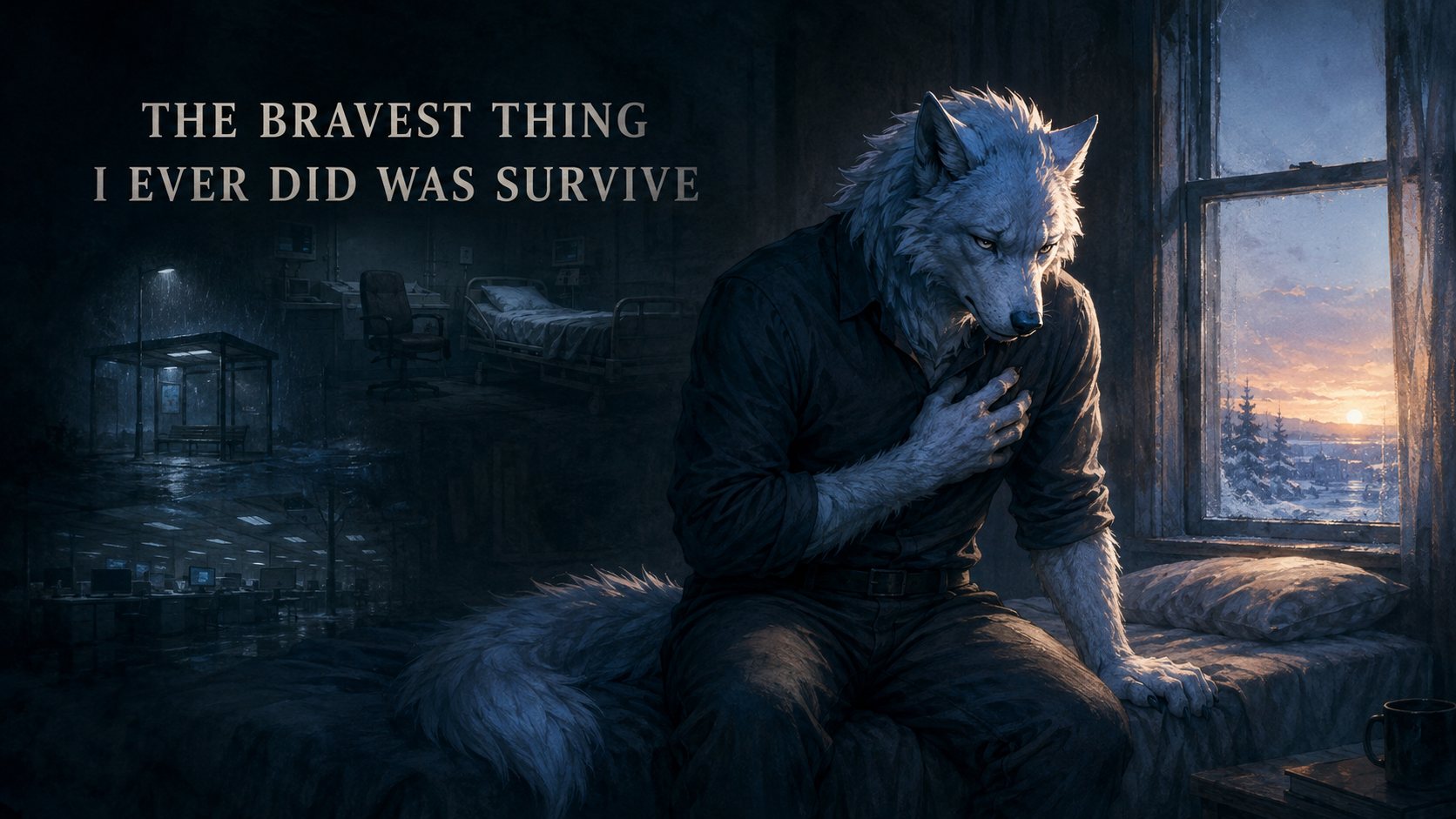
This audiobook reached me because I understand the separation between logic and fear. I can know a room is safe while my body refuses to believe it. I can understand why my mind reacts, trace where the reaction began, and still find no switch that turns it off. Years of examining my own psychology have taught me that knowledge is a map, not an exit. Benedict’s new body standing inside old fear gave that truth a fantasy shape I could hear and feel. At moments, the performance made me clench my teeth and push emotion behind ice so I would not lie down and cry. That is not empty praise. A story can hurt because it is careless, or because it touches something accurately enough that the guard wolves inside the mind wake up. Heavenly Chaos did some of both. Its central recognition felt true, while its quick emotional solutions sometimes felt like doors appearing where my own experience taught me there would still be walls.
I also know what it means to continue because stopping feels more dangerous. After my father died, I chose to go to work the next day because staying home alone with my mind would have made the storm worse. From outside, that can look like exceptional strength. From inside, it can be emotional triage, one routine used to keep the darkness from filling every room. Benedict’s training, cooking, study, and determination spoke to that survival method. Yet the book sometimes comes close to praising endurance without fully asking what it costs. His Regeneration allows him to accept punishment that would destroy other people, and instructors admire his refusal to stay down. “An Alpha is not proven by how much blood he can lose before the snow takes him. He is proven by knowing when survival means letting the pack carry his weight.” Strength is not only another repetition, another shift, another battle, or another smile while something inside remains numb.
The chosen-family element struck just as deeply. Benedict wants closeness but expects it to become a weapon. Atropos wants to be touched without being used, yet her own body makes touch dangerous. Sadie wants people who value her beyond bloodline, sex, family expectation, or usefulness. I understand wanting warmth while keeping one paw against the door. The best parts of their bond do not demand that fear vanish before belonging begins. They create rules, leave room, return the next morning, and try again. That is what a dependable pack means to me. It is not a group that promises no one will ever cause pain. It is a group that does not turn pain into proof that someone must be abandoned. The book’s language of healing can become too polished, but its belief that consistent care matters is not naive. A den becomes safe through hundreds of ordinary returns, and Heavenly Chaos understands that truth even when it occasionally rushes the moment a frightened wolf finally sleeps.
Final Verdict: A Strong Beginning That Stops Before Its Battle
Heavenly Chaos is best for listeners who want character-focused progression fantasy, academy life, cultivation mechanics, found family, cooking, therapy, and extremely slow romantic development. It is not the right choice for anyone seeking constant action, a fully formed harem in Book One, morally complex villains, or a self-contained tournament arc. Newcomers can begin here without knowledge of Schinhofen’s other series, and the system is explained clearly enough for listeners who are not cultivation experts. People with histories involving child abuse, bullying, sexual violence, panic, or depression should approach carefully. The book is compassionate, but the performance makes that pain immediate, and its repeated conversations may either feel validating or emotionally exhausting. I would continue the series because the mock war, Benedict’s unknown bloodline, Atropos’ development, Sadie’s place in the group, and the wider world all deserve the chance to move beyond preparation. I would listen to Andrea Parsneau again without hesitation.
The precise 4.07/5.00 reflects an audiobook whose emotional ambition and performance rise above its structural problems. Regeneration is an excellent power because it asks what perfect bodily recovery means when memory still braces for impact. Benedict and Atropos build trust through meaningful action, and the domestic warmth gives their future more substance than simple attraction. Parsneau turns fear, tenderness, humor, and combat into a living performance. The missing fraction lies in repeated routines, therapy language that sometimes becomes too exact, a world held at a distance, visible editing flaws, simple antagonists, and an ending parked outside the event meant to complete the semester. When the final words faded, I could see tracks leading from Gilfle Academy into the storm, deep and promising, then stopping at the transport gate. My final howl from HowlStrom is this: “The audiobook heals enough to make me trust its path, but it ends before its claws touch the mountain it taught me to climb.”


Leave a Reply