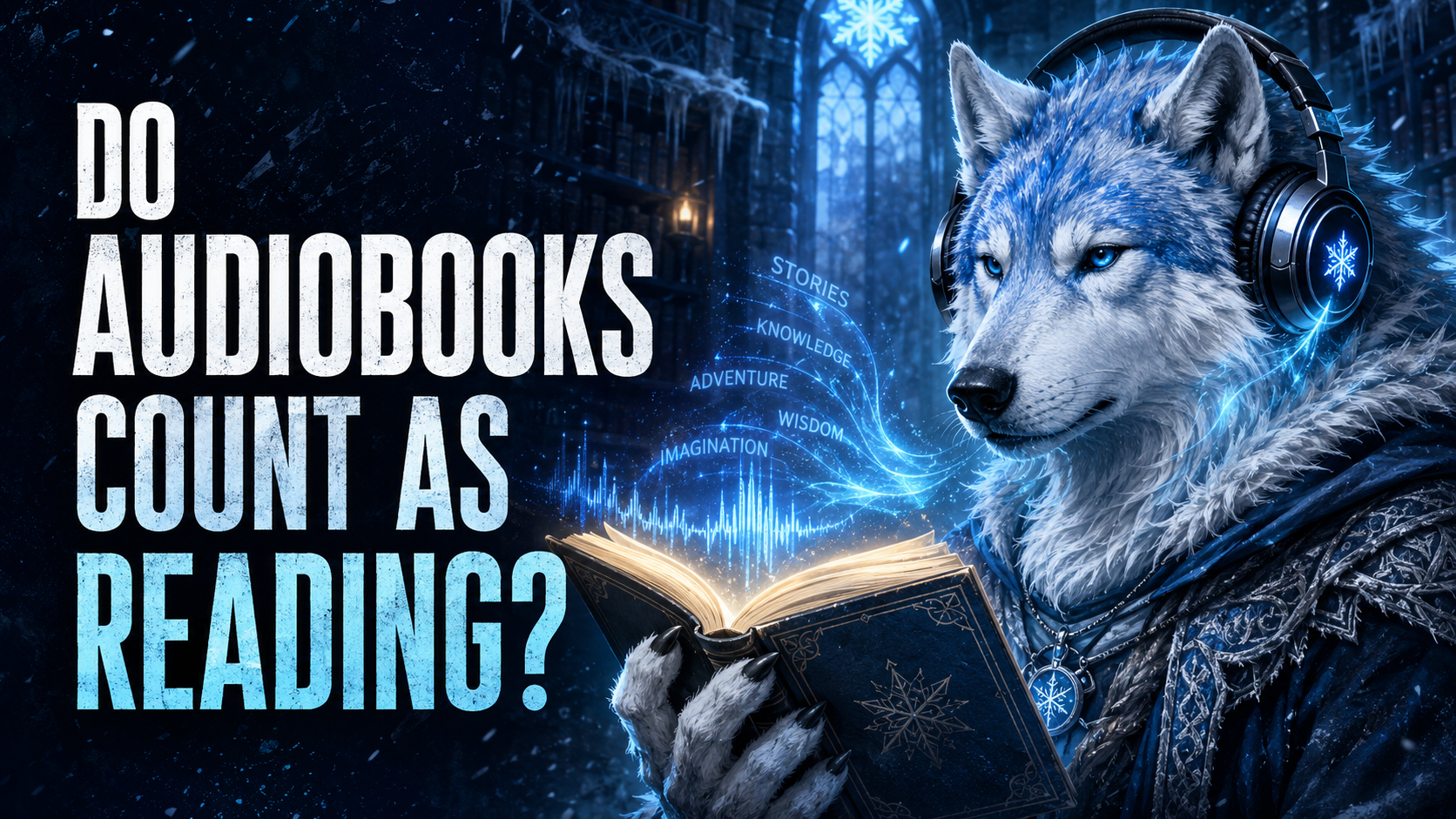



Some gates are built from iron and stone. Others are built from a single word. In book culture, “reading” has become one of those words. It can describe a practical way of receiving language, but it can also function as a badge of intelligence, education, patience, and cultural worth. That is why the question of whether audiobooks count as reading rarely remains a calm argument about definitions. For many audiobook listeners, it carries an accusation beneath the surface: you took the easy path, you did not perform the correct labour, and therefore the story does not belong to you in quite the same way. As an audiobook listener who enters roughly 140 books a year through my ears, I reject that hierarchy. However, defending audiobooks does not require pretending that listening and visual reading are identical, or repeating scientific claims more confidently than the evidence allows.
On 21 January 2025, author John Green addressed this dispute in the vlogbrothers video “Do Audiobooks Count As Reading?”
He had recently spent a day recording the audiobook of Everything Is Tuberculosis, and he used that experience to reflect on how both the audiobook industry and his own attitude had changed during the two decades since Looking for Alaska. His central argument is clear: audiobooks are a legitimate form of reading, they can make books more accessible, and listening should not be treated as intellectually inferior to reading with the eyes. He also recognises something that many discussions miss, which is that an audiobook has expressive possibilities that print does not possess.
My judgment is that Green gets the central ethical and cultural point right. Audiobook listeners are not counterfeit readers, and receiving a book through performance does not make the resulting understanding unreal. His strongest factual claim, however, goes too far. The video says that most people retain more information from audiobooks than from print. The broad research record does not establish that. The more defensible conclusion is that listening and reading often produce similar average comprehension, while individual ability, attention, self-pacing, text type, purpose, and testing method can change the result. Audiobooks deserve equal legitimacy because they genuinely carry language, meaning, emotion, and knowledge, not because audio must defeat print in a scientific contest.
What John Green Is Actually Arguing
Green begins with a personal history rather than a universal theory. When his first novel was published, audiobooks were still strongly associated with boxes of tapes or CDs, and an audio edition felt like a rare adaptation performed by an actor. He admits that he once placed written language on a pedestal. He understood what print could do, but because he did not listen to many audiobooks, he had not yet learned what narration could add. That admission matters. He is not claiming that he conducted a detached survey of the industry in 2005. He is describing the limits of his former experience and explaining why contact with the format changed his position.
His strongest artistic point is that the losses between formats run in both directions. A listener may miss visual wordplay, unusual spelling, typography, page layout, or the ability to study a paragraph at a glance. A visual reader may miss a spoken pun, a rhythm hidden inside a sentence, or an emotional possibility revealed by inflection. Green uses Ulysses as an example of a work containing both visual and audible language. More broadly, he argues that a narrator can bring a book to a different kind of life. He does not say that print and audio are the same experience. In fact, he explicitly distinguishes them. Print lets the reader control pauses and visual movement more directly, while audio gives the narrator greater influence over pace, emphasis, and interpretation.
The title presents a yes or no question, but the full argument is more careful than a slogan. Green’s position is that both formats can carry a person into the ideas and emotional world of a book, even though they use different sensory routes. He supports that with his own practice of moving between print and audio according to his situation. He can listen while washing dishes and read visually before bed. Because he understands and remembers the continuing book in either format, he considers both activities reading. That personal test does not settle every scientific question, but it explains the meaning of his conclusion. He is defending continuity of engagement with a book, not claiming that ears have secretly become eyes.
One Word Is Carrying Two Different Questions
Much of this conflict survives because “reading” is being asked to perform two jobs. In a narrow literacy sense, reading means interpreting written or tactile symbols. Visual print reading involves recognising letters, words, punctuation, and layout. Braille reading performs comparable symbolic work through touch. Listening to speech does not exercise that exact process. If a school is measuring a child’s ability to decode written English, an audiobook cannot demonstrate that skill on the child’s behalf. Saying this is not an insult to audiobooks. It is a description of different language processes.
In ordinary cultural conversation, however, “reading a book” often means completing and engaging with the work. If a book club asks whether I have read a novel, the practical questions are whether I know the plot, encountered the language, understand the characters, and can discuss the ideas. An unabridged audiobook normally provides that access. Insisting that I answer “no” because my eyes did not perform the delivery would obscure more information than it clarified. I may add that I listened when the format matters, especially during a review, but that does not make the broader word dishonest.
Context therefore decides which definition is useful. “Did this pupil read the paragraph aloud?” concerns decoding and fluency. “Have you read the new novel?” concerns familiarity with a work. “How did you read it?” asks about format. “What did you understand?” asks about comprehension. These are connected questions, but they are not interchangeable. A large part of the online battle could disappear if people stated which one they meant before sharpening their fangs.
Green mainly uses the broad cultural meaning. That is reasonable for a short video about access, literature, and adult choice. The limitation is that his description of reading as making words and ideas transparent risks treating decoding as wasted friction. For an experienced adult seeking a story, reducing unnecessary friction may be exactly what is needed. For someone learning literacy, decoding is itself an essential skill that requires practice. Green is not presenting a literacy curriculum, so this omission does not invalidate his argument. It does mean that “audiobooks are reading” should not be stretched into “listening develops every skill that print develops.” Equal legitimacy does not require identical mechanics.
The Retention Claim Goes Beyond the Evidence
The point where I must press my claws into the ice is Green’s repeated claim that most people retain more information from audiobooks than from printed books. That is a large population claim. To support it, research would need to show a reliable audio advantage across representative people, materials, conditions, and meaningful measures of retention. The available evidence is much more mixed, and the broadest relevant synthesis does not show that most people generally learn better through audio.
A meta-analysis by Virginia Clinton-Lisell combined 46 studies with 4,687 participants across age groups. The estimated overall difference between reading and listening comprehension was small and not statistically reliable. That supports parity on average, not general audio superiority. The analysis also found important moderators. Reading showed a small advantage when the written material was self-paced, and it performed better on some measures of inferential and general comprehension. Literal comprehension was more similar. These findings make sense because a visual reader can stop, scan backward, compare passages, and allocate extra time without operating playback controls.
A separate 2016 experiment by Beth Rogowsky, Barbara Calhoun, and Paula Tallal randomly assigned 91 participants to receive the same nonfiction material as a digital audiobook, an ebook, or synchronised audio and text. The researchers found no statistically significant differences in immediate comprehension or in retention measured two weeks later. That study offers meaningful evidence that audiobook listening can be as effective as visual reading under those conditions. It does not prove that all formats are equal for every person or every book. The participants were proficient, native English-speaking college graduates, the study used selected nonfiction material, and the testing environment cannot reproduce every real listening situation.
Even the word “retention” needs precision. Immediate recall, memory two weeks later, recognition of literal facts, inference, practical application, emotional memory, and the ability to quote exact wording are different outcomes. A listener may remember a character’s emotional journey vividly while forgetting how a name was spelled. A print reader may remember where a fact appeared on the page while missing the vocal rhythm that made a scene work. A student studying a technical chapter has different needs from a fantasy listener following a battle through headphones. Compressing all those outcomes into one claim about what “most people” retain creates a clean sentence, but the snow beneath it is thinner than it looks.
Brain imaging is often recruited to settle the argument, but it must be handled carefully. A 2019 study by Fatma Deniz and colleagues found that semantic tuning during reading and listening was highly correlated across many meaning-sensitive regions of the cortex. That supports the idea that both routes can build closely related representations of meaning. It does not show that the whole brain behaves identically, that every listener remembers equally well, or that sensory format never matters. The study involved nine adults, and it examined patterns of semantic representation rather than proving equal educational outcomes across the population. Similar meaning-related activity is important evidence, but a brain scan is not a magical stamp declaring two experiences identical.
The fair correction is therefore straightforward. Research provides no good basis for calling audiobook listening an intellectually empty shortcut. In many controlled comparisons, comprehension is similar. Some people will genuinely understand more through audio because decoding print consumes too much effort, because narration sustains attention, or because spoken delivery suits the material. Others will learn more from text because they can control the pace, inspect structure, annotate, and revisit details. Green’s moral conclusion survives this correction. His statistical wording does not need to be true for audiobook listeners to belong inside the reading world.
Equal Legitimacy Does Not Mean Identical Skills
Audiobooks can transmit vocabulary, argument, narrative structure, factual knowledge, humour, and emotional meaning. They can expose a listener to language far beyond what that person might willingly or comfortably approach in print. They do not directly show spelling, paragraphing, punctuation, typography, footnote placement, or the visual organisation of a page. A listener can recognise that a sentence sounds awkward without knowing whether the printed punctuation contributed to the problem. A visual reader can inspect a fantasy name without knowing how the author or production expects it to sound.
This distinction is especially important in education. If the goal is to learn history, an accessible audiobook may remove a decoding barrier and let the student engage with the history itself. If the goal is to practise reading unfamiliar words, audio alone cannot replace that practice. If the material contains equations, maps, diagrams, tables, code, or dense cross-references, a linear recording may be inadequate even when the narration is excellent. The answer is not to deny the student audio. It is to provide formats designed around the actual learning task, often including structured navigation, synchronised text, descriptions, supplementary material, and the freedom to combine methods.
The W3C’s EPUB accessibility guidance illustrates why this matters. Synchronised text and audio can preserve table-of-contents navigation, phrase-level movement, logical reading order, and control over secondary material such as footnotes. Without meaningful structure, an audio user can become trapped inside long tables, references, or sidebars that a visual reader could scan or skip. The DAISY standard was developed for a similarly navigable reading experience for people with print disabilities. Accessibility is not achieved merely by placing one enormous audio file beside a textbook and declaring the gate open.
Green is right that the absence of audio editions can become a barrier to learning. The correction is that educational access requires more than narration. A fully useful accessible edition must respect how a student searches, studies, quotes, checks a page reference, returns to a heading, and separates the main text from supporting material. The best solution may be audio, print, Braille, structured digital text, or a combination. A fair system lets the learner choose the tools that fit the task instead of forcing one method to perform every possible job.
The Narrator Becomes Part of the Book We Experience
Green’s most valuable audiobook-specific insight is that audio is not simply print poured through a speaker. An audiobook is a performed and produced edition. The author supplies the written language, but a narrator decides how that language moves through time. Pauses, emphasis, breath, emotional restraint, character voices, pronunciation, and rhythm all guide interpretation. Even a careful narrator cannot avoid making choices. A line that remains ambiguous on the page may sound sarcastic, frightened, loving, or cold once spoken.
This is why a strong narrator can elevate material for me. The performance may reveal humour I would not have generated internally, distinguish a large cast, or give emotional weight to prose that looked ordinary. The reverse is also true. Unclear character voices, distracting pronunciation, badly judged pacing, or an emotional delivery that clashes with the scene can damage my experience of good writing. Neither outcome proves that the narrator is a good or bad person. It means the performance is part of the published product I bought and therefore a legitimate subject for review.
Responsibility must still be separated carefully. Plot, characterisation, dialogue, prose, and world-building normally originate with the author and editorial process. Vocal interpretation generally involves the narrator and direction. Duplicated lines, missing passages, intrusive noises, unstable volume, poor mastering, and incorrect chapter divisions may come from editing, engineering, production, or the files delivered by a platform. Unless evidence identifies the decision-maker, I should criticise “the production,” “the audio edition,” or “the release” rather than placing every fault at one person’s paws.
Author narration also deserves a more careful discussion than “the author knows the book best.” An author may offer unmatched personal authority, especially in memoir or nonfiction, and may know exactly where the emotional pressure belongs. That does not automatically provide acting range, breath control, consistent character separation, or professional pacing. A trained narrator may perform the text more effectively while interpreting some lines differently from the author’s private voice. Neither choice is universally superior. Casting should serve the work and the intended listening experience.
This is also why audiobook reviews should not collapse everything into one verdict. A weak story can receive a remarkable performance. A strong novel can have a technically flawed release. Sound design may enrich an audio drama while distracting someone who prefers a clean single-narrator production. A reviewer can evaluate story, performance, and technical production separately without pretending that any of those judgments is perfectly objective. Observable defects can be documented. Taste still matters. The narrator’s voice may simply be unsuitable for my ears while remaining skilled and effective for another listener.
Access Requires More Than an Argument About Vocabulary
Audiobook access has consequences far beyond whether someone is allowed to add a title to a reading challenge. The United States National Library Service for the Blind and Print Disabled, for example, provides audio and Braille materials to people whose blindness, low vision, physical disability, perceptual disability, or reading disability makes print difficult to use. That service exists because access to books is access to education, culture, independence, pleasure, and participation. When someone dismisses audio as a lesser imitation, the statement may sound like harmless pedantry to the speaker while landing as exclusion to the person whose practical route into books has just been declared invalid.
Disability is not the only valid reason to listen. People use audiobooks while commuting, walking, exercising, performing routine work, cooking, or resting their eyes. Some listeners concentrate better when their hands are occupied. Others need to sit quietly. Some move between audio and text. Nobody should have to disclose a diagnosis or produce a history of struggle before being allowed to enjoy a narrator. Accessibility benefits disabled people directly, but flexible design often helps the entire pack.
At the same time, convenience does not guarantee attention. A listener folding laundry may follow every line, while someone navigating unfamiliar traffic may miss an entire scene. A visual reader can also stare at a page while thinking about something else. The relevant variable is not merely which sensory organ received the words. It is whether attention remained connected to them. Digital bookmarks, rewind controls, sleep timers, chapter navigation, speed adjustment, and synchronised text help listeners recover control, but they do not abolish the limits of working memory.
That matters when people use quantity as evidence of superiority. Finishing more books through audio does not automatically mean understanding them better. Finishing fewer books in print does not prove deeper engagement. My own yearly total tells readers that I have extensive experience with audiobooks. It does not turn every interpretation I make into fact. The substance of my review still has to show that I followed the book, understood its choices, and can explain my judgment.
A Huge Market Still Does Not Give Everyone Equal Choice
Green’s memory of a small audiobook business followed by a digital explosion is broadly supported by present industry data. According to the Audio Publishers Association’s 2026 research summary, participating publishers reported US receipts of $2.43 billion in 2025, continuing 15 years of annual growth. They reported more than 750,000 active titles, and digital audio accounted for 99 percent of revenue. The association’s consumer research estimated that 58 percent of American adults had listened to an audiobook at least once. These are trade-association survey results rather than a global census, but they leave little doubt that audio has moved far beyond a small specialist format.
Growth does not make Green’s phrase “reader choice” universally true. A print book may have no audiobook edition. A series may receive audio for its first volumes and then stop. A narrator may change halfway through. An edition may be restricted by country, held behind one platform, priced beyond a listener’s budget, or unavailable through the local library. Independent authors may face production costs they cannot safely recover. Digital distribution removed the need to manufacture and ship a box of tapes or CDs, but professional narration, direction, editing, proofing, mastering, artwork, metadata, and quality control still require labour.
This is especially visible in the genres I know well, including LitRPG, progression fantasy, HaremLit, superhero fiction, dungeon stories, and isekai. Audio listeners may spend hundreds of hours with the same narrator and cast. A release delay or casting change is not a small cosmetic detail when those voices have become the audible identities of long-running characters. Print readers can often continue as soon as the ebook appears. Audio-first listeners may wait months, lose continuity, or face a choice between changing format and leaving the series unfinished.
Platforms also shape what “choice” means. A convenient app can provide speed control, bookmarks, synchronisation, and easy purchasing while still tying access to an account, region, subscription, or proprietary system. Libraries widen access, but licences and waiting lists can limit availability. The digital market has opened many gates, yet some of those gates still have corporate locks. Celebrating growth is justified. Treating growth as proof that every listener can obtain every book in a usable format is not.
Why the Debate Feels Like a Judgment of the Person
Reading has accumulated moral status. Many people were praised as children for reading difficult books, and they may connect visual reading with discipline, intelligence, and identity. When another format delivers the same story with less struggle, effort justification can enter the conversation. Human beings often value an achievement partly because it was difficult. If I climbed an icy mountain, I may feel protective of the climb when someone else arrives by another route. The mistake is assuming that my labour defines the only legitimate reason for reaching the view.
Audiobook listeners can become defensive for equally understandable reasons. Someone who has repeatedly been called lazy, fake, or less intelligent may hear even a narrow linguistic distinction as another attack. Rejection sensitivity does not mean that the person is irrational or disordered. It means previous exclusion can change the threat carried by a familiar phrase. A person saying “technically, you listened” may intend precision. In a community that constantly uses the same correction to rank people, the impact can become contemptuous even when each speaker denies hostile intent.
Group behaviour intensifies the conflict. Print loyalists repeat examples confirming that listeners become distracted. Audiobook defenders repeat brain-scan headlines suggesting that the experiences are identical. Each side protects its identity with the facts that feel safest. That is identity-protective reasoning in plain language: evidence is evaluated partly by whether it protects the group and self-image to which a person belongs. Social media then rewards the sharpest version, because “it depends on the person, material, goal, and controls” does not travel as quickly as “audiobooks are cheating” or “science proves they are exactly the same.”
Green pushes back against the harmful hierarchy, and I agree with that choice. My criticism of his retention claim comes from the same principle. We should not answer one exaggeration with another. If later evidence contradicts a statement that helps my side, I still have to follow the evidence. Otherwise I am only guarding my den with a different set of comforting stories. Audiobooks do not need scientific superiority to deserve respect. They need honest recognition of what they actually accomplish.
What Years of Audiobook Listening Have Taught Me
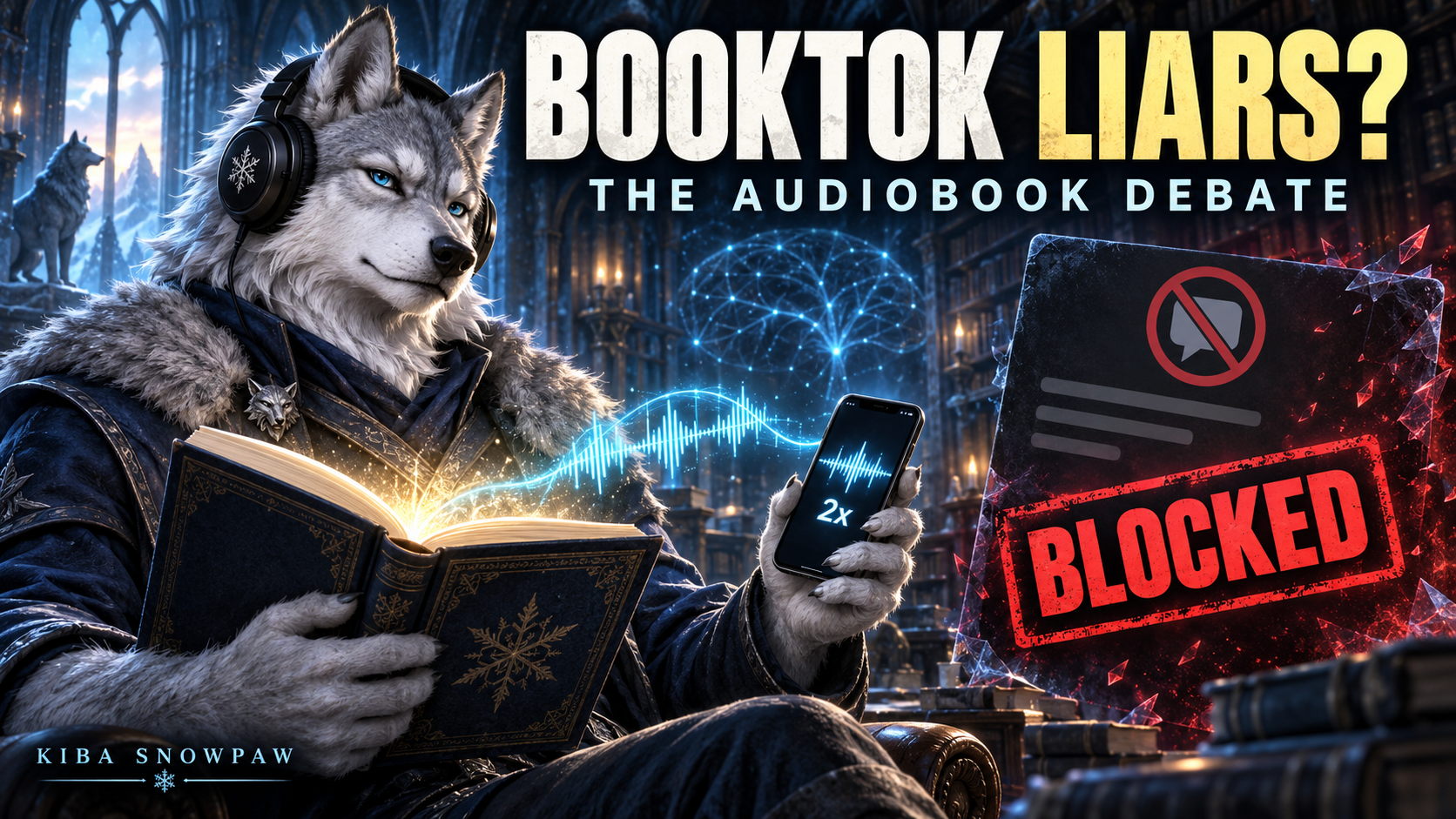
I do not enjoy reading printed books or ebooks for pleasure. Audiobooks are my primary route into stories, and I listen to roughly 140 in a typical year. I usually listen at 2x speed because a slower pace often gives my thoughts more room to wander. At the right speed, my attention stays close to the narration. Another listener may need 1x speed, a slower narrator, synchronised text, silence, or frequent pauses. My experience tells me that personal fit matters. It does not prove that 2x is better for the human brain or that everybody should train themselves to use it.
I have bought hundreds of audiobooks and written many Goodreads reviews. That experience has taught me to separate familiarity from certainty. I can recognise patterns across long series, performances, genres, and production styles, but another listener can reasonably respond differently. A narrator who makes a world vivid for me may overwhelm someone who prefers restrained delivery. A repeated game-system explanation in a LitRPG audiobook may help one listener and frustrate another. Taste is not a technical defect, yet technical competence does not force personal enjoyment.
My ratings are designed to keep different judgments independent. Enjoying an audiobook does not automatically make every element worthy of 4 or 5 stars. A powerful narrator cannot erase weak character development. Excellent world-building cannot repair broken audio files. A story can be emotionally meaningful while containing clumsy wording or repetitive exposition. Honest criticism should identify the layer being judged and explain why it affected the experience. It should never leap from “this performance did not work for me” to “this narrator has no talent,” or from “this plot choice failed” to “the author is a bad person.”
When I say I have read a series, I am using the normal cultural meaning. When I review its audiobook, I say I listened because the format becomes evidence. I discuss the narrator, pacing, voices, pronunciation, and production where relevant. I can judge audible grammar, dialogue, repetition, and sentence flow, but I should not pretend I inspected spelling or page layout that I never saw. If playback speed contributes to a pacing complaint, I should consider that before blaming the performance. Honesty works in both directions.
For me, an audiobook is not a shortcut around stories. It is the road that lets me reach them. It has carried enormous worlds into ordinary days and given a voice to characters who might otherwise have remained outside my gates. Books can provide companionship during long, tired, or silent hours without requiring me to claim that every detail was retained perfectly. Emotional value is real even when it cannot be reduced to a comprehension score. That is perspective from one ice wolf’s life, not a universal law for the whole forest.
Better Standards for a Healthier Audiobook Culture
A healthier discussion does not require everyone to use the same definition in every context. It requires enough precision to stop a definition from becoming a weapon. It also requires publishers, platforms, educators, listeners, and reviewers to recognise that equality of access involves practical design, not just approving words.
- Name the purpose. If the question concerns decoding, spelling, literary analysis, factual study, entertainment, or familiarity with a story, say so. Different purposes can produce different format needs.
- State the format when it matters. Audiobook listeners can reasonably say they read a book. Reviewers should still identify the audio edition when narration or production forms part of the judgment.
- Separate the layers of the release. Story, prose, narration, direction, editing, mastering, metadata, platform delivery, and marketing should not be treated as one person’s responsibility without evidence.
- Build genuine accessibility. Educational and reference audio needs navigable chapters, logical structure, page references where appropriate, descriptions of visual information, and access to supplementary material.
- Preserve listener control. Reliable bookmarks, rewind controls, speed adjustment, sleep timers, accurate chapter divisions, synchronised text, and stable files help listeners manage attention and revisit information.
- Use research precisely. “Comprehension is often comparable on average” is supported. “Audio is always equal,” “print is always superior,” and “most people retain more from audio” are broader than the evidence justifies.
- Stop making format a character test. Difficulty is not proof of virtue. Convenience is not proof of laziness. A person does not owe the community a disability, diagnosis, or confession before choosing audio.
For educators, this means measuring the skill they actually intend to teach instead of treating every language activity as the same test. For publishers, it means regarding audio as a real edition that deserves casting, proofing, navigation, metadata, and quality control. For reviewers, it means being specific without becoming cruel. For communities, it means asking what someone discovered in a book before demanding proof that their eyes travelled across every page. Precision should open understanding, not close the gate.
Final Judgment: Keep the Gate Open
John Green is right that the old hierarchy placing visual readers above audiobook listeners is too narrow. He is also right that audio contains artistic possibilities unavailable to print, that narrators can transform the experience of a text, and that wider audiobook availability gives more people access to stories and information. His video is especially strong when it speaks from experience and recognises that the two formats differ without ranking one human being above another.
Where I disagree is with the claim that research shows most people retain more from audiobooks. The best broad evidence I found points instead toward average similarity, with meaningful differences created by self-pacing, inference demands, individual ability, attention, language, text type, and purpose. That correction does not weaken the case for audiobooks. It makes the case more honest. Audio belongs because listeners can comprehend, interpret, remember, feel, and discuss books through it, even though it does not reproduce every visual literacy skill.
So yes, in the ordinary and culturally meaningful sense, audiobooks count as reading. In a technical discussion of sensory processing or literacy instruction, listening and visual reading should be distinguished. Those positions can coexist without contradiction. We gain nothing by forcing every route into one identical footprint, and we lose readers when we turn format into a measure of personal worth.
At the gates of HowlStrom, I care less about whether the words crossed the snow through someone’s eyes or ears than whether they reached the mind, stirred something honest inside the chest, and returned with knowledge worth carrying home to the den.

Leave a Reply